 Home
Home
|
Table of Content - Volume 19 Issue 1 - July 2021
COVID-19 vaccine acceptance by health care personnel in Pune city, Maharashtra
Pawan Chavhan*, Yallapa Jadhav, Varsharani Kendre, Murlidhar Tambe, Malangori Parande, P S Borle, Ganesh Jagdale, Ravishankar Shivshette
Department of Community Medicine, B J Government Medical College, Pune, INDIA. Email: drchavhanpawan@gmail.com
Abstract Background: The global pandemic Covid-19 is a communicable disease caused by SARS - CoV-2. Health care professionals are at high risk of getting Covid-19 infection as frequency and duration of contact with Covid-19 positive patients is very high as compared to general population, so protection of health care workers should be the first priority. The aim of this study is to estimate the prevalence of Covid-19 vaccine acceptance and reluctance, and socio-demographic and other factors associated with it. Material and Methods: This cross sectional study was conducted in Feb 2021. Google forms containing structured questionnaire of this study was sent to health care workers working in Pune city through email/what’s app and though text massage. Important socio-demographic characteristics like age, gender, occupation, income, marital status, h/o comorbidities, desire, acceptance, reluctance and reason for not getting Covid-19 vaccine are questioned. Results: In the study, 412 HCWs participated and completed the questionnaire, including 235 (57.04%) men and 177 (42.96%) women (Table 1). Most participants were in the range of 18-30 years of age (49.51%). Most participants were doctors (77.19%). About 67.72% of HCWs were vaccinated for Covid 19. HCWs with comorbidities were only 12.62 % and rest i.e. 87.38 % had no comorbidities. Among all HCWs 19.42% were tested positive previously and 80.56% were negative for Covid-19. HCWs having family member suffered from Covid-19 were of 26.75%. HCWs about 36.89% were strongly agreed that vaccine will prevent them from complications of Covid-19 disease, only 4.12% were disagreed and 0.48 strongly disagreed for the same. About 54.85 % of HCWs were strongly agreed that vaccination is important for health of others in their community and nearly 48.30 % of HCWs were completely confident in using local manufacture Covid-19 vaccine while 23.3 % of HCWs showed confidence in foreign (imported) vaccine. About 45.87 % of HCWs agreed that vaccine will protect them from Covid-19 disease. Conclusion: Acceptance of Covid-19 vaccine is varied among HCWs by their age group, education, occupation and income. Knowledge about the vaccine should be increased in HCWs about the Covid-19 vaccine so as to increase vaccination coverage in HCWs as well as general population.
INTRODUCTION Covid-19 is a communicable disease caused by SARS-CoV -2. This disease was spread very rapidly all over the world, so WHO declared it as global pandemic on 11 March 2020(1). As on 01st Feb 2021 this pandemic had 102 million confirmed cases and 2.2 million deaths all over the world.2As of 1st Feb 2021, In India 10.7 million confirmed cases and 0.154 million deaths. There are 46312 active cases and cumulative deaths are 51082 in the state of Maharashtra as of 1stfeb 2021. (3). In Pune city there are 186204 confirmed positive cases and 4766 confirmed deaths of Covid-19 till 1stfeb 2021 (4). Pune is the second city in the Maharashtra state after Mumbaito breach the 1000 cases. It took 47 days for Pune to cross 1000 casessince it reports its first two cases on March 9, 2020.5Health care professionals are at high risk of getting Covid-19 infection as frequency and duration of contact with Covid-19 positive patients is very high as compared to general population so protection of health care workers should be the first priority .Many preventive measures like hand sanitization, wearing mask and social distancing are helpful in preventing the Covid-19 disease but to reduce mortality and morbidity, vaccination is most essential public health intervention.6 In developing country like India, even about routine immunization there are many myths and rumors and as Covid-19 vaccines were approved by CENTRAL DRUG STANDARD CONTROL ORGANIZATION (CDSCO) as an emergency use approval, so misconception about these vaccines are more. Because of incomplete information and various rumors in social media about vaccination, vaccine reluctance has become major obstacle in Covid-19 vaccination. Identifying, understanding, and addressing vaccine acceptance (i.e. a position ranging from passive acceptance to active demand),7 and vaccine hesitance and resistance (i.e. the positions where one is unsure about taking a vaccine or where one is absolutely against taking a vaccine) (8) to a vaccine for COVID-19 is, therefore, a potentially important step to ensure the rapid and requisite uptake of an eventual vaccine. As HCWs having more knowledge about risk and adverse effects of new vaccine compared to general population, so there seems to be some vaccine hesitancy among healthcare workers. The first human clinical trial of a COVID-19 vaccine commenced on March 3rd, 2020 in the United States, Based on Strategic Advisory Group of Experts on Immunization (SAGE), vaccine hesitancy is the term used to describe: “delay in acceptance or refusal of vaccination despite availability of vaccination services”.9 Factors that affect the attitude towards acceptance of vaccination include complacency, convenience and confidence [9, 10]. Complacency denotes the low perception of the disease risk; hence, vaccination deemed unnecessary. Confidence refers to the trust in vaccination safety, effectiveness, besides the competence of the healthcare systems. Convenience entails the availability, affordability and delivery of vaccines in a comfortable context.10 MATERIAL AND METHODSThis was an observational cross sectional study, conducted in February 2021. The structured questionnaire in English language and in local language(Marathi) was designed on the Google Form platform. This Google formwas sent to health care workers working in Pune city through email/what’s app or though text massage. Permission of Institute Ethics Committee (IEC) was taken (IEC Ref No.BJGMC/IEC/Pharmac/ND-Dept. 0221070-070). All participants were informed about the objectives of the study and their right whether to choose to participate or not to participate in the study. A written informed consent was obtained from all participants by sending it through Google forms. Full confidentiality of respondent’s information was kept and information was used only for research purpose. Questionnaires were divided into 3 sections, section A comprising of questions related to socio-demographic profile, section B included questions related to acceptance of Covid-19 vaccine and section C comprising the questions related to reluctance of Covid-19 vaccine. The survey assessed socio-demographic profile of Health Care Workers (HCWs), their acceptance and reluctance regarding Covid-19 vaccine. The data was tabulated and analyzed using Epi Info and MS Excel. Descriptive statistics (percentage, mean, standard deviation, minimum, and maximum) were used to describe socio-demographics characteristics.
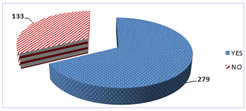
RESULTSIn this study, total of 412 HCWs participated and completed the questionnaire, including 235 (57.04%) male and 177 (42.96%) female (Table 1). Mean age of the participant was 33.7+12.1 years, ranges from 18 to 72 years; most participants (49.51%) were in the range of 18-30 years of age. Most participants were doctors (77.19%). About 67.72% of HCWs were vaccinated for Covid-19. Among all responses 57.04 % were graduates and 23.54% were post graduates, response of private practitioner was of 14.81%. About 39.56 % of HCWs had income between 50 thousands to 1 lac and 24.51% had income more than 1lac.About 67.72 % of HCWs were vaccinated for Covid-19 vaccine (Figure 1).Among the 412 HCWs, 52(12.62%)had one and or the other comorbidity.Among all HCWs, 80 (19.42%) were tested positive previously for Covid-19. Family members of 110 (26.75%) HCWs had suffered from Covid-19. When asked to rate their health on their own, then about 295 (71.6 %) HCWs rated their health as very good and 49 (11.89%) HCWs rated as excellent.When the acceptance of Covid vaccine related questions/information were asked to HCWs, about 152 (36.89%) were strongly agreed that vaccine will prevent them from complications of Covid-19 disease, only 17 (4.12%) were disagreed and 2 (0.48%) strongly disagreed for the same (Table 3). About 226 (54.85 %) of HCWs were strongly agreed that vaccination is important for health of others in their community and nearly 199 (48.30 %) of HCWs were completely confident in using local manufactured Covid 19 vaccine while 96 (23.3 %) of HCWs showed confidence in foreign (imported) vaccine. More than half 212 (51.45%) of HCWs think that vaccine came too early. About 29.32 % of HCWs said that they didn’t take vaccine because they want to prefer wait and watch to see its effect on others (table 4). About 68.68% HCWs were disagreed that they would not need vaccine if they already suffered Covid disease.Nearly 42.71% HCWs were disagreed that Covid 19 vaccine would interfere their usual activities. About 45.87 % of HCWs agreed that vaccine will protect them from Covid-19 disease.Table 1: Socio-demographic profile of study participants
Figure 1: Covid 19 vaccination status of study participants
Table 2: Reasons for acceptance of Covid-19 vaccine among the study participants
Table 3: Reasons for reluctance of Covid-19 vaccine among the study participants
DISCUSSIONVaccination is the one of the most important public health intervention of 21 century. The vaccine against COVID-19 is on Horizon. India’s government had been already started with roll out vaccination for the priority group. HCWs, including doctors are getting vaccinated for the COVID-19. Acceptance of vaccination is varied with age, gender, socio-economic status and human behavior also. About 412 HCWs responded to the questionnaire. Though limited studies are available to explore the intention to take Covid-19 vaccine, our results are in accord with the study conducted in China and in the United states.11,12 The Chinese study conducted by Fu et al. stated 72.5% of study participants having intention to take vaccine while that of United States reported 80% acceptance of Covid-19 vaccine, in our study about 83.73% participants were agreed that vaccine will prevent complications of Covid-19. 79.85 % participants were confident in using the local manufactured Covid 19 vaccine. About 91.01% participants were agree that getting vaccinated is important for health of community also. About 45.87% of participants were agreed that Covid 19 vaccination will protect them from Covid disease. Also 67.72% of HCWs were vaccinated for Covid-19. In the present study, participants who were hesitant about the Covid 19 vaccine, main reasons were that they thought vaccine came too early without the proper clinical trials and due to the possible side effects of the Covid 19 vaccines. This means that they would require a little bit of assurance before the vaccination drive is carried out. The strengths of the study were that it give the idea about the reasons for the Covid-19 vaccine acceptance and reluctance. Our study has limitations also as it is the cross sectional study it depicts the response at the point of study. The real intention may be different when the vaccine is available.13 Also the responses were recorded using self-administered survey forms by Google forms, instead of direct face to face interview. CONCLUSIONAcceptance of Covid-19 vaccine is varied among HCWs by their age group, education, occupation and income. Vaccine hesitancy is the major obstacle in implementing vaccination campaigns. Knowledge about the vaccine should be increased in HCWs about the Covid-19 vaccine so as to increase vaccination coverage in HCWs as well as general population. As HCWs are among the first to receive the vaccine, their concern about the safety of the vaccine should be addressed as early as possible.14 Various strategies should be planned and implemented for the increase in vaccine acceptance among the HCWs.
REFERENCES
Policy for Articles with Open Access
|
|
||||||||||||||||||||||||||||||||||||||||||||||||||||||||||||||||||||||||||||||||||||||||||||||||||||||||||||||||||||||||||||||||||||||||||||||||||||||||||||||||||||||||||||||||||||||||||||||||||||||||||||||
 This work is licensed under a Creative Commons Attribution-NonCommercial 4.0 International License.