 Home
Home
Official Journals By StatPerson Publication
|
Table of Content - Volume 7 Issue 3 - September 2018
Tracheostomy timing in prolonged ventilation: Early versus late
Nishanth Savery1*, Jayita Poduval2, Mary Kurien3
1Assistant Professor, 2Associate Professor, 3Professor and HOD, Department of ENT, Pondicherry Institute of Medical Sciences Puducherry, INDIA. Email: docnishuu@gmail.com
Abstract Aims: There appears to be a paucity of reports from Indian subcontinent regarding ideal timing for performing tracheostomy in intubated patients requiring prolonged ventilation. This study was done to assess the advantages of performing early tracheostomy (7 days and less) as compared to late tracheostomy (more than 7 days) with regard to weaning off ventilator, association of complications, mortality, length of hospital stay including injury to larynx and trachea. Materials and Methods: Our prospective descriptive study had 47 consecutive already intubated patients admitted in the intensive care unit of a tertiary hospital who underwent tracheostomy for prolonged mechanical ventilation. They were divided into two groups depending on when tracheostomy was done as Group A (early tracheostomy) and Group B (late tracheostomy) and analysed for the above mentioned outcomes measures using statistical software SPSS 20. Results: Group A, which had 23 patients required shorter duration of ventilator support, and reduced hospital stay, both being statistically significant, as compared to Group B with 24 patients. Group B, in addition, had more incidence of ventilator associated pneumonia and two mortality with significantly higher laryngoscopic evidence of epiglottic cordal and tracheal ulceration. Conclusion: Our study of intubated patients in ICU suggests early tracheostomy (between five - seven days) for prolonged ventilation as there is significant evidence of earlier weaning from ventilator support, reduced hospital stay with no mortality and lesser incidence of laryngeal / tracheal complications. Clinical Significance: For critically ill patients requiring prolonged mechanical ventilation in the intensive care unit of a developing country like India, early tracheostomy is suggested, the ideal time being five to seven days. Key Words: Orotracheal intubation, Prolonged Ventilation, Tracheostomy timing.
A large number of patients in the intensive care unit need prolonged tracheal intubation for various reasons like assisted ventilation, upper airway obstruction, tracheo-bronchial toilet and weaning failure. Prolonged endotracheal intubation is associated with need for sedatives, in addition to trauma to larynx, trachea, and patient discomfort. Tracheostomy, which plays an integral role in the airway management of such patients, avoids injury to the pharynx and larynx, in addition to reducing the dead space and decreases ventilatory efforts with easier trachea-bronchial toilet.1 In a developing country like India, with suboptimal availability of Intensive Care Units (ICUs) and economic burden of health care primarily borne by majority of patients, its timing is variable in various centers. This study was undertaken as an attempt to optimize the ideal time for performing tracheostomy in critically ill patients requiring long term ventilation in the intensive care unit.
MATERIALS AND METHODS This is a prospective study of 50 consecutive already intubated patients, requiring prolonged mechanical ventilation, admitted in the intensive care unit of Pondicherry Institute of Medical Sciences, from January 2012 to February 2013.The study included patients with head injury, respiratory paralysis due to neurological diseases, non-corrosive poisoning and febrile illness.Details regarding weaning off the ventilator, association of complications, mortality and length of hospital stay were noted. Follow up was done with fiberoptic laryngocopy at discharge, one month and six months later for any injury in the pharynx, larynx and trachea. Patients they were then divided into two groups, depending on the day when tracheostomy had been done, as Group A (early tracheostomy – seven or less days) and Group B (late tracheostomy – later than seven days). Statistical Analysis: The data were analysed in terms of the above mentioned outcomes measures using statistical software SPSS 20. Descriptive analysis was done using a chi-square test and T test.
RESULTS There were 50 patients in this study. Among them, three were lost follow up; two patients from group A and one from group B as they were discharged against medical advice. Thus 23 patients from Group A and 24 patients from Group B were analysed. The study had 47 subjects, with ages between 17-75 years with a mean age 40 years, male to female ratio 3.7: 1.3 in Group A with tracheostomy being done between 5-7 days. Group B had mean age of 50 years with male to female ratio of 3.4:1.6 and tracheeostomy done beyond 7 days. The baseline characteristic in both the groups regarding etiology was comparable as shown in table 1.
Table 1: Indication for ventilation
Table 2: Duration of ventilation after tracheostomy:
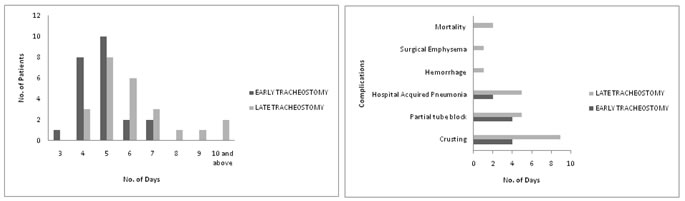
Statistical analysis by T test showed significant difference between mean of the groups (P value - 0.04) Figure 1: Duration of ventillation after tracheostomy Figure 2: Post tracheostomy complications
Late group had more patients with hospital acquired pneumonia and had two deaths. However, these were not statistically significant.
Table 3: Length of stay in hospital
*Group A had shorter duration of hospital stay (<30 days) and Group B had longer duration of hospital stay (> 45 days), both being statistically significant. Table 4: Fibreoptic laryngoscopic findings
wks – weeks, *- significant P value *Ulcerations of the epiglottis, vocal cords and trachea appears to be more common in group B at the end of six weeks, which was statistically significant.
DISCUSSION Tracheostomy, which is performed to replace endotracheal intubation in patients who are expected to require prolonged mechanical ventilation provides early airway protection and has been found to decrease the need for prolonged mechanical ventilatory support.1,2,3 Majority of the subjects in our study required prolonged mechanical ventilation for head injury from road traffic accidents. This can be attributed to the strategic location of our hospital on the National highway making it easily accessible to road traffic accident victims. The second common cause is cerebrovascular accident, followed by organophosphorous poisoning. In our study, the patients in the early tracheostomy group required 4 to 5 days of additional ventilator support in contrast to those in the late tracheostomy group who required 5 to 9 days of additional ventilator support which was statistically significant (figure 1, table 2), Following tracheostomy there is a reduction of ventilatory dead space, less airway resistance and easier trachea bronchial toilet which contribute to better weaning from the ventilator.4Similar findings were observed by other authors.5,6 A recent systematic review of 41 studies with 222,501 adults and two studies with 140 pediatric patients was done by Adly et al for determined the cut off timing for early tracheostomy. Studies that considered early tracheostomy were those done within the first 7, 14 or 21 days of endotracheal intubation in adults and within the first 7 days of endotracheal intubationin pediatric age group. There was a significant difference in favor of early tracheostomy in adults and children (within 7 days) regarding reduced duration of mechanical ventilation.7 In the present study complications were clinically more significant in the late tracheostomy group. Among them, hospital acquired pneumonia was more common with two deaths, while there was no death in the early tracheostomy group (Figure 2). However, on analysis, it was not statistically significant. This could probably be due to the small sample size. Adly et al in their recent systmatic review reported significantly reduced mortality in both children and adults with less hospital-acquired pneumonia in adults.7Chintamani et alin their study of 50 patients admitted to the surgical emergency with isolated closed head injury, concluded that early tracheostomy is beneficial (in terms of decreased mortality and intubation associated complication) in patients’ with GCS score of <8 and SAPS (Simplified Acute Physiology Score) score of >50 for more than 24 hours.8A recent observational prospective study of ICU patients by El-Anwar et al reported complications of 13.9% tracheal stenosis and 25% subglottic stenosis in patientswho had open approach technique (surgical) tracheostomy done within 17 to 26 days (mean of 19.4 ± 2.07 days) after intubation.9 Our study noted that the length of hospital stay was significantly shorter in the early tracheostomy group (30 days or < versus >45 days) (Table 3). This observation was also noted by Brook, et al who reported that those subjects who underwent early tracheostomy (<10 days) revealed a decrease in both duration of mechanical ventilation (28.3 vs 34.4 days) and ICU length of stay (15.6 vs 29.3 days). This was also reflected in a lower cost of hospitalisation for the patients who received tracheostomy within 10 days.10 Adly et al in their recent systematic review also reports that early tracheostomy was superior in reducing duration of stay in ICU in both adults and children. These authors too have concluded that early tracheostomy within 7 days of intubation be done for both adults and pediatric patients requiring prolonged intubation.7 There was statistically significant fibreopticalryngoscopic evidence of longer time for healing of mucosal injury (ulceration) of larynx and trachea in the late tracheostomy group as compared to the early group in our study (Table 4). This was also reported by Santos, et alin their study of 79 patients following prolonged orotracheal intubation.11 It revealedlaryngoscopic evidence of laryngeal oedemain 94%, ulceration in 76% and granulomas in 44% patients, majority of them being formed 4 weeks after intubation.
CONCLUSION The present study reveals significant evidence of earlier weaning from ventilator support, reduced duration of hospital stay and lesser incidence of laryngeal / tracheal complications with no mortality in the group of patients who had tracheostomy within five to seven days of orotracheal intubation. Clinical Significance: In an already intubated patient requiring prolonged ventilation, to successfully overcome local and general, often life-threatening complications associated with prolonged endotracheal intubation, in a developing country like India, an early tracheostomy to be considered, ideal timing being fifth to seventh day of oro-tracheal intubation.
REFERENCES
|
|
 This work is licensed under a Creative Commons Attribution-NonCommercial 4.0 International License.