 Home
Home
Official Journals By StatPerson Publication
|
Table of Content - Volume 11 Issue 2 - August 2019
Prevalence of refractive errors among primary school children in Kangra, Himachal Pradesh, north India
Vandna Sharma1*, Rajeev Tuli2, Gaurav Sharma3, Vinod Dhiman4
1,2,3,4Department of Ophthalmology, Dr RPGMC, Tanda, Kangra, H.P., INDIA. Email: vandna.27@rediffmail.com
Abstract Background/Aims: One of the most common causes of ocular morbidity in school going children in India is refractive error and its related visual impairment which has significant impact on school performance1. There is a lesser data available regarding childhood visual impairment due to refractive error in Himachal Pradesh. So, to assess the magnitude of the problem the present study was conducted among the school going children aged 5-11 years in Kangra district. Methods: A cross sectional study was conducted in primary coeducational schools, both government and private schools randomly selected and about 1007 school children were examined from May 2015 to May 2016. Preliminary examination was carried out at their respective schools and detailed ophthalmic examination was done in ophthalmology department of tertiary centre. Results: Refractive errors (39%) constituted the major cause of ocular of ocular morbidity in present study in both government and private school going children. The overall prevalence of refractive errors was 12.8%, amblyopia 2.4% and squint 1.9%. Myopia was found in 3.3% and hypermetropia in 9.5%. Results suggested that 85% of children were with uncorrected refractive error. The school performance was average in 45.1% children and poor in 16.1 % children. Conclusions: A school eye screening cum intervention programme with periodic evaluation seems to be appropriate in this region of North India as there is a high prevalence of refractive error as major cause of visual impairment which was significantly affecting school performance of children due uncorrected refractive error. Key Words: Refractive errors, visual impairment, prevalence, school performance, school children
INTRODUCTION Visual impairment at birth or during childhood can affect communication, employment, health, quality of life and the effects are lifelong2. Refractive error is one of the most common cause of visual impairment around the world and second leading cause of treatable blindness1. The visual impairment due to refractive error is potentially preventable or curable if early attention through eye screening is given1. The overall incidence of refractive errors has been found to vary between 21% and 25% of patients attending eye outpatient departments in India3. Data on the prevalence of refractive errors is needed for planning and evaluating preventive and curative services for children, including planning special education and low vision services4. Children do not complain of defective vision, and may not even be aware of their problem. They adjust to their poor vision by holding books close to the face, sitting close to black board in classroom, blinking excessively and frequent rubbing of eyes. So this affects learning ability, performance and adjustment in school, and overall development of a child. Later on, it may have a negative impact on social health and employment opportunities. In competitive world of today, good physical and mental health is indispensable. To get employment in certain fields like navy, military, railways and aviation good visual acuity is essential. So the effective methods of vision screening in school children are useful in detecting correctable causes of decreased vision, especially refractive errors and in minimizing long-term visual disability4. In developing countries, 25% of the population represents school going children. Moreover, schools provide one of the best platforms for effectively implementing the comprehensive eye healthcare programme4,5. There is a lesser data available regarding childhood visual impairment due to refractive error in Himachal Pradesh. This study is of great importance as it will provide valuable data on prevalence of childhood ocular morbidity. Moreover, it will lead to early diagnosis and initiation of treatment and also enable those with low vision and color vision defects to choose appropriate vocation and training.
MATERIALS AND METHODS The study was conducted in Kangra block, Himachal Pradesh, North India among school-going children of age 5-11 years from selected schools from May 2015 to May 2016. Kangra is a most populous district, situated in eastern part of Himachal Pradesh. According to 2011 census, it has a total population of 1,510,075 with 94.29% in the rural area and 5.71% urban area 6.A total 1007 children of government and private schools were screened in present study. It included 506 children of 14 government schools and 501 children of 3 private schools with 48.65% males and 51.34% females. Majority of children screened were from age group 8-9 years. Children studying in coeducational schools did not differ much in terms of culture, religion, ethnic values and socioeconomic status. However, the difference existed in private and government schools in terms of more fees and better infrastructure. Hence, generally children from upper and high middle socioeconomic status got admission in these schools. In government schools, school fees were minimal and students from all the socioeconomic strata got admissions. The principals of the selected schools were informed about the study and permission for the visit to the selected schools was sought personally. The data collection instrument was a pretested semi structured interview cum examination proforma was used. All study subjects were interviewed as per attached proforma after getting written informed consent from the teacher/parent/guardian. First part of it included demographic information, ocular complaints if any and school performance. Second part of it included the preliminary ophthalmic examination for diagnosing ocular morbidity. Visual acuity was assessed using Snellen’s vision chart with optotypes on each line at 6-meter fixation distance. Visual acuity testing was done monocularly with one eye covered with occulder and performed under normal daylight illumination. If the subject was not able to read the Snellen’s types at a distance of 6 m, he/she was asked to move 1 m towards the chart till he/she was able to read the first line of the Snellen’s chart. If the subject still could not read the chart from a distance of 1m, he/she was asked to count fingers at a distance of 1 m and vision recorded as ‘FC at 1 m’. If subject could not count fingers at 1 m he/she was asked to count fingers at a distance of 1 foot and vision recorded as ‘FC at 1 ft’. Suitable corrective lenses were applied in subjects with visual impairment and the best corrected vision was recorded. WHO-recommended definitions of visual disabilities were adopted in our study81. The cut off of uncorrected visual acuity for defining ocular morbidity due to refractive error in this study was taken as a visual acuity of ≤6/9 in the worst eye. Ocular motility was evaluated in all six cardinal positions of gaze and in nine diagnostic positions. Axis deviation was assessed with cover /uncover test and categorized as esotropia, exotropia, or hypertropia and the degree of tropia measured using Hirschberg test. Similar method of examination was followed in government and private schools. All the children present in the class at the time of visit were examined in one sitting. All the study subjects were clinically examined with torch-light. Those who required special examination process were advised to come to department of ophthalmology, Medical College, Kangra where further evaluation and appropriate treatment was given with consent of parents or guardians. Data thus collected was entered into Epiinfo 3.2 version software. Descriptive analysis was done; quantitative variables were tested with Chi-square t test for assessing the level of significance. Differences were considered to be statistically significant at the 5% level. RESULTS A total of 1007 school children of age group 5-11years were screened for ocular morbidity which included 506 children from 14 government schools and 501 children from 3 private schools. This study included 48.65% males and 51.34% females, both had equal representation. Moreover, almost equal number of children from government schools (50.2%) and private schools (49.8%) were screened in the study.
Table 1: Gender breakdown of students in selected schools
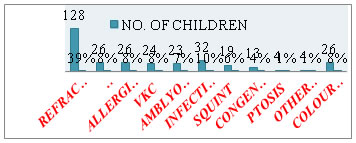
Refractive error was major cause of visual impairment accounting 39%, amblyopia (7%), squint (6%), followed by other causes like infective eye diseases (10%), conjunctivitis (16%), vitamin A deficiency (8%), and miscellaneous eye disorders (14%). Figure 1: Pattern of ocular morbidity in primary school going children in age group 5-11yrs in dist. Kangra. The overall prevalence of refractive errors 12.8%, amblyopia in 2.4% and squint 1.9%.
Table 2: Pattern of ocular morbidity in school going children in age group 5-11yrs
Myopia was found in 3.3% and hypermetropia in 9.5%. Higher prevalence of refractive errors in younger age group (5-9years) was seen because there was high prevalence of age-related hypermetropia (8.5%) in young children. This relation was found to be statistically significant. Table 3: Relation between age and spectrum of refractive errors
Majority of primary school children had visual acuity in normal range 6/6 -6/ 18 in either eye. Whereas, one child (0.1%) had moderate visual impairment with visual acuity in range <6/18-6/60 and none had severe visual impairment with vision in range <6/60-3/60.
Table 4: Best corrected visual acuity (BCVA) in the better eye in Snellen’s notation
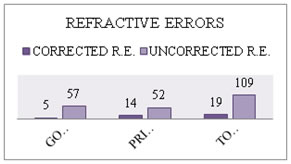
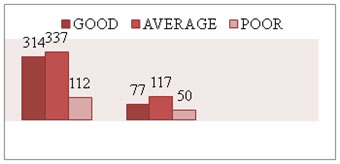
The prevalence of refractive error in government schools (12%) and private schools (13%) was almost similar. There was no gender difference for prevalence of refractive errors. There was significant relation between age and refractive error. Results suggested that 19 (15%) children had already corrected refractive error with glasses as compared to 109 (85%) children with uncorrected refractive error. Figure 2 Figure 3 Figure 2: Children with corrected and uncorrected refractive error (R.E.) in both government and private schools Figure 3: School performance of children with out and with refractive error. In this study, school performance was significantly affected by uncorrected Refractive errors. Majority of children (45.1%) had average school performance and 16.1 % had poor school performance. DISCUSSION Eyes are the most treasured organs of a human being. Although vision is very important for all ages but it is more so in case of children as it plays a key role in their mental, physical and psychological development7. Screening school children is arguably the second largest national programme for control of blindness in India after cataract surgery8. The current work, conducted in Kangra, confirms the high prevalence of refractive errors among high school students in North Indian area and highlights the urgent need to implement at school level health facility-based, cost-effective strategies, and appropriate eye care programs targeting school children. Thus, it will reduce the burden of visual impairment in the younger population in this region of North India. Various studies done in India and other developing countries quoted the spectrum of various types of refractive disorders as leading cause of visual impairment in school-going children 8. Similarly in this study, prevalence of refractive error was most common cause of ocular morbidity, seen in 12.8 % children (Table-2), which is higher than the study conducted by Gupta et al. in U.P. 9, and Kumar et al. in Delhi10, who reported prevalence 6.8% and 5.4% respectively. In contrast, the study done by Biswas et al.11 in West Bengal found higher prevalence of refractive errors (23%). Similarly, higher prevalence of refractive errors has been observed among school going children in Shimla4 and Ahmedabad12.International studies from Africa13, Nepal14 and Nigeria15 noted lower prevalence of refractive errors in range of 2.7-5.8% among children of age 5-15 years as compared to the present study. These differences may also be explained by the different diagnostic criteria used by different authors, racial or ethnic variations in the prevalence of refractive errors, and different lifestyles or living conditions. The current study showed prevalence of squint in 1.9% children (Table -2), which is comparable to the prevalence 1.3% observed by Shrestha et al. in Kathmandu valley 16. In comparison to this study higher prevalence of squint was reported from previous studies conducted in North India by Pratap et al17 and by Gupta et al4, who observed the prevalence 2.8% and 2.5% respectively. Similarly, studies conducted in West Bengal and Delhi also observed higher prevalence of squint (7.4% in 5-15 years) than the current study18,19. Whereas, lower prevalence was found by Desai et al5 in Rajasthan (0.2%) and Khurana et al20 in Haryana (0.6%) in 4-18 years age group. Studies done abroad revealed lower prevalence of squint (0.5%) by Wedner et al., among children of 7-19 years in Tanzania, Africa13. In the present study prevalence of amblyopia was found to be 2.3% (Table-2) which is much higher than reported from other studies13,16,. The most common cause for amblyopia noted by these studies was refractive error which was similar to this study. It was found to be more (2.8%) among students of government schools than private schools (1.8%). This may be due to more aware parents of private school going children than parents of government school going children.As per result of current study, majority of primary school going children had visual acuity in normal range 6/6 -6/18 (Table-14). Only one child (0.1%) had moderate visual impairment with visual acuity in range <6/18-6/60 in better eye, which was much lower than observed in the study conducted by Rustagi et al.21 in rural Delhi, reported vision < 6/60 in 0.93% children. However, this result of present study is comparable to similar studies conducted among rural and urban school-aged children from other parts of India8. Results showed that prevalence of refractive errors in government schools (12%) and private schools (13%) were almost similar. The current study also included school performance of every child and its relation with refractive error was also determined. Results suggested that school performance was significantly affected by uncorrected refractive error. Majority of children (45.1%) had average school performance (figure 3). Results also suggested that 15% children had already corrected refractive error with glasses as compared to 85% children who were not aware of refractive error (figure 2). So, present study strongly highlights the need of early detection and treatment of diminished visual acuity due to refractive error as it plays an important role in preventing the eye from becoming amblyopic and thus preventing social and intellectual underdevelopment of the child. This requires intervention at school level by appropriate eye care programmes to propagate awareness in school children regarding the importance of ocular health care.
REFERENCES
|
|
|||||||||||||||||||||||||||||||||||||||||||||||||||||||||||||||||||||||||||||||||||||||
 This work is licensed under a Creative Commons Attribution-NonCommercial 4.0 International License.