 Home
Home
Official Journals By StatPerson Publication
|
Table of Content - Volume 11 Issue 2 - August 2019
Community perspective from an ophthalmologist’s eyes: Negligence and quackery
Shovna Dash1, Gayatree Mohanty2*
1,2Department of Ophthalmology, Kalinga Institute of Medical Sciences and Pradyumna Bal Memorial Hospital, Bhubaneswar, Odisha, INDIA. Email:mgayatree@gmail.com
Abstract Background: Despite advances in ophthalmology, traditional beliefs and superstitions persist till date to ward off the evil eye in India. The primary purpose of this study is to observe the incidence of advanced stage ocular diseases with irreversible visual loss at the time of presentation and analysis of the role of patients’ negligence and quackery in its causation, at the same time looking upon the strategies to sort this perennial problem. Material and Methods: An observational study was done over a year with advanced stage ocular ailment, wherein visual loss was irreversible. All subjects underwent detailed clinical history taking and comprehensive ocular examination, and cases were analyzed with respect to 1) Demographics, 2) The cause of such a late stage presentation, 3) Any treatment received previously, 4) The first portal of treatment and 5) Time to have received primary care. Result : Of the 57 patients included in the study, 27 patients were being treated by a general practitioner or local ophthalmologist elsewhere and had followed up with us as a referral to a tertiary care centre. However, of the rest 30, 16 (28%) cases presented late due to negligence of the patient and 14 (24.5%) were treated inappropriately by quacks. Conclusion: Besides patient education, it is a collective responsibility of health professionals and law enforcement bodies to take urgent action and practical steps to stop quackery to save salvageable vision. Key Words: Negligence, Quackery, Referral.
INTRODUCTION India is a developing country, the burden of blindness being one of the biggest challenges. Many patients present to an ophthalmologist in advanced stage of disease, due to their own negligent attitude. Besides, our country is still tied down by myths and superstitions and struggling towards eradication of quackery. Lack of timely referral to higher centre is another pitfall. Purpose of this study is to observe the incidence of advanced stage ocular diseases and analyse role of patients’ negligence, quackery and lack of timely referral in its causation, at the same time looking upon strategies to sort this perennial problem.
MATERIALS AND METHODS An observational study was done over a year to study patients presenting for the first time to our outpatient department, with advanced stage ocular ailment, wherein visual loss was irreversible. Our hospital based study has been approved by the institutional ethics committee according to the tenets of the declaration of Helsinki. Our study included 57 patients ranging in age from 2-76 years. All subjects underwent detailed clinical history taking and comprehensive ocular examination, after taking a well informed consent regarding discussion about their illness, and cases were analyzed with respect to 1) Demographics, 2) The cause of such a late stage presentation, 3) Any treatment received previously, 4) The first portal of treatment and 5) Time to have received primary care.
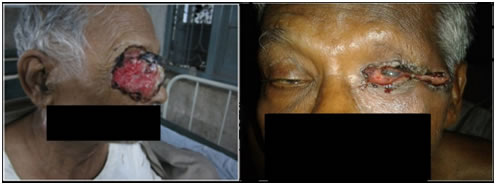
RESULT The entire population was rural based, with a large proportion (68%) being males. The patients ranged in age from 2 to 76 years. Of the 57 patients included in the study, 27 patients were being treated by a general practitioner or local ophthalmologist elsewhere and had followed up with us as a referral to a tertiary care centre. However, of the rest 30, 16 cases presented late due to negligence of the patient and 14 were treated inappropriately by quacks. Of the 27 cases who had been referred to us from the remote peripheral areas, 16 had been sent by a general practitioner (GP), after a failure at treatment, and 11 were referrals from a general ophthalmologist for specialised ophthalmology care. All four cases of Glaucoma were being treated with anti-glaucoma medications by the general ophthalmologist for years together, with change of drugs and various multi-drug regimens, but to no avail. On presentation, the vision was no more salvageable due to intense nerve fibre damage. Similarly, the two retinal detachment cases, were diagnosed and referred by the local ophthalmologist too late for surgical re-attachment to restore good vision. Of the four uveitis patients, two cases of tubercular uveitis were being treated by a general practitioner repeatedly with topical steroids, but the macula suffered at the expense of posterior extension of uveitis, while in the other two cases who were in consultation with general ophthalmologist, vision succumbed to steroid-induced glaucoma. Four of the endophthalmitis patients were being treated by the GP as conjunctivitis and ended up in panophthalmitis by the time they reached us, while another one was referred late by the local ophthalmologist after initial treatment with antibiotics and steroids. The two cases of retinoblastoma were diagnosed late due to lack of equipments in periphery. Six of the corneal ulcer patients were being treated by a general practitioner with multiple topical and oral medications till it was too late for vision to be salvaged. The four diabetic patients being pursued by the GP were blinded by diabetic retinopathy in absence of a regular ophthalmic evaluation. The remaining 30 cases whose vision succumbed to patient negligence and quackery included three cases of Basal cell Carcinoma, 11 of Retinoblastoma, one Plexiform Neurofibroma, five Meibomian carcinomas, three Buphthalmos cases, five Endophthalmitis and two Panophthalmitis. Of these, all three cases of buphthalmos, nine cases of Retinoblastoma, two cases of Basal cell carcinoma and two cases of endophthalmitis presented at a late stage due to their own negligent nature and apathy towards their ailment, by which time their vision was not salvageable. While amongst the rest 14, who had lost their sight to some crude treatment measures, the first portal of treatment was the village quack. All five meibomian carcinoma cases and the sole case of Neurofibroma were subjected to one or more excisional measures, one of the meibomian carcinoma patient presenting to us in the stage of metastasis to cervical and pre-auricular lymph nodes (Figure 1). One of the Basal cell carcinoma patient was prescribed some ayurvedic medications with an assurance of the lesion being a simple wart (Figure 2). The history procured from the patients who presented to us in the extreme stages of Endophthalmitis and Panophthalmitis (Figure 3), not just cut a sorry picture, but was in simple words, horrifying. While in most, the extracts of various plants were instilled into the eyes, right at the onset of their symptoms, in some others the materials administered topically by the local quack ranged from grounded sea shells to even common salt. Even worse, the white glow in a child’s eye who came to us with Stage V of retinoblastoma, was in the very beginning considered to be a lucky charm (Figure 4).
Figure 4 Figure 3
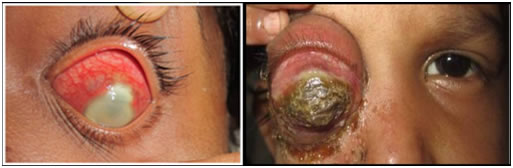
Figure 3 Figure 4 DISCUSSION Recent estimates show that there are 324 million people who are either blind or visually impaired in the world and that the burden of blindness and visual impairment (VI) is disproportionately clustered in the developing countries, including India. With 8 million blind people and 62 million VI, India shares almost a quarter of the entire global burden of blindness and VI.1 Misery would be one of the words, to say the least, about the life of a patient lost to blindness. One of the prime reasons of this misery in ophthalmology is a lack of awareness on part of the common man. Many cases fail to receive a timely and appropriate treatment due to self negligence. This may be in part due to apathy and also due to misconceptions. The underlying reasons may also be a lack of services in the extreme peripheries and rural areas, lack of money amongst the poorer lot for conveyance to a higher centre and so on. The answer to many of these issues is, increasing the level of awareness amongst the common man, be it through media or through grass-root level workers. Besides, a system of timely referral to a higher centre still fails to exist. This compounded with the lack of medical equipments and facilities in the peripheral centres adds to the delay in a timely intervention to curb the preventable blindness. There ought to be a rule for timely referral by general practitioner or ophthalmologist. If one has trouble diagnosing or achieving improvement in a particular condition, one ought to seek opinion from a specialist. For example, a general practitioner should always refer a diabetic patient to an ophthalmologist to rule out diabetic retinopathy despite a perfect vision and an urgent referral in presence of diabetic nephropathy. Conducting continued medical education workshops would help in creating awareness about referral. In order to meet the objective of eliminating avoidable blindness, eye units have to ensure that they have the equipment they need so they can work quickly and effectively with the help of sight saving organizations. The issues in corneal causes of blindness and visual impairment relate to both ensuring that the patients engage in right health seeking behaviour when in need as well as to ensure that the providers have both the skills for making the right diagnosis and the required infrastructure. A lot of corneal injuries happen in the rural areas and mostly during the peak agricultural seasons. Often such injuries are minor when they happen and there is a tendency to ignore it or resort to local harmful practices. The institutions that provide eye care facilities are also not all equipped with the basic laboratory facilities to identify the organism causing the infection for starting effective medication. Thus, there is a need to work both at the community and the institutional level for awareness generation. Specific infrastructure for detection and management of childhood blindness is not available at primary and secondary health care system of the country. For posterior segment disease like diabetic retinopathy or retinoblastoma at early stage, detection is presently not possible at the primary and even some secondary centres. 2Quackery has been existing since ages and continues to haunt our country even today, to a magnitude that is unfathomable. Not many of us might be aware of how the legend musician Johann Sebastian Bach’s vision succumbed to the quackery of his times, wherein to our awe, what was instilled into his eyes topically after surgery was eye drops of blood from slaughtered pigeons, pulverized sugar or baked salt. Yes, not everyone is Johann Bach to make it to the headlines, but vision is priceless and when it comes to vision, no man, rich or poor, deserves anything less than the correct and the best treatment. 3All said and done, what an Ophthalmologist can do, besides saving eyes, is to spread awareness in the society. And this is possible through a camp-based approach of screening for ocular diseases in the rural and impoverished areas. This will provide us with not just an opportunity to catch the diseases early, but it can also be taken as an opportunity to propagate the correct knowledge and clear misconceptions. Today almost 4 million are blind because of diabetes, which is terrible because it is avoidable. Few years ago doctors could do little to tackle this problem. Currently however the scenario is far different. Today any diabetic blindness is a failure on part of the doctor and the medical system. What is needed is regular screening as well as a dissipation of knowledge and understanding amongst patients.
CONCLUSION Community ophthalmology is not a part of Ophthalmology, it is the heart of Ophthalmology, because it is the community to which we doctors are catering to, whether they come to us or we go to them. We ought to reach the grassroot level. As Hellen Keller said, the only thing worse than being blind is having sight but no vision. What is needed today is the vision of having a blindness free society, giving in all that can be.
REFERENCES
|
|
 This work is licensed under a Creative Commons Attribution-NonCommercial 4.0 International License.