A study of astigmatism induced by cataract surgery in relation to the type of incision
Asha Achar
Assistant Professor, Department of Ophthalmology, Kanachur Institute of Medical Sciences, Deralakatte, Mangalore.
Email: dr.shishirkumar091010@gmail.com
Abstract Astigmatism is one refractory error that is constantly encountered after the cataract surgeries. Corneal astigmatism appears to be associated with cataract surgeries since the surgeries commonly involves the incision of the cornea. Whether any one type of the incision is more dangerous than the other is the question that is troubling a lot of ophthalmologists. This study is one such attempt to understand the Astigmatism induced by cataract surgery in relation to the type of incision.
Key Words: Astigmatism, Cornea, Incisions, Cataract, Complications.
INTRODUCTION
Astigmatism is one refractory error that is constantly encountered after the cataract surgeries1. Corneal astigmatism appears to be associated with cataract surgeries since the surgeries commonly involves the incision of the cornea. With increased patients expectation and improved techniques, surgeons have been paying close attention to the astigmatic effects of the surgery that involves the corneal incisions. Since the early days, the incision for cataract surgery has undergone a metamorphosis2-6. The length and the different precisions of the incisions, the types of the sutures and the suture material have all been examined and modified7,8. The ultimate goal has been the ability to predict and then control the astigmatic changes that are bound to take place during and after the cataract surgeries. Work has been altered continuously and all the process of this alteration has caught up the pace in the last decade and this has ultimately led to the use of incision that close with no suture at all9,10. It has been understood that the location, size and configuration of the wound, suture material and also the technique in suture closure influences the amount of post – operative astigmatism. Whether any one type of the incision is more dangerous than the other is the question that is troubling a lot of ophthalmologists. This study is one such attempt to understand the Astigmatism induced by cataract surgery in relation to the type of incision.
AIMS AND OBJECTIVES
To Study the Astigmatism Induced by Cataract Surgery in Relation to the type of Incision.
MATERIALS AND METHODS
This study was conducted on surgically induced astigmatism following cataract Surgery performed at Department of Ophthalmology Kanachur Institute of Medical Sciences, Mangalore
Selection of Cases
75 patients were selected and grouped as follows:
Group A : 25 Ab Externo Extra Capsular Cataract Extraction
Group B : 25 Sclero corneal valve incision surgery
Group C : 25 Clear corneal valve incision surgery
Inclusion Criteria:
Patients of either sex
All adult patients with visual disability
All cataract patients with normal fundus
Exclusion Criteria
Children less than 12 years
Grossly altered corneal topography Post-operative vitreous loss with vitreous touch syndrome
Post operative uveitis with corneal oedema
Aphakic and pseudophakic bullous keretopathy
Pre Operative Assessment
Patients were admitted one day before proposed date of surgery. Detailed history was taken from each patient.
Sampling Method
The amount of astigmatism induced by cataract surgery is compared with respect to type of incision.
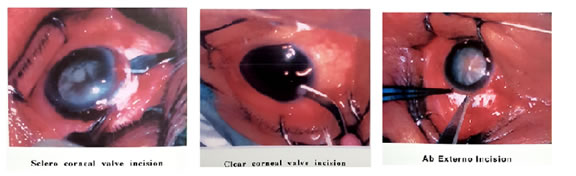
RESULTS
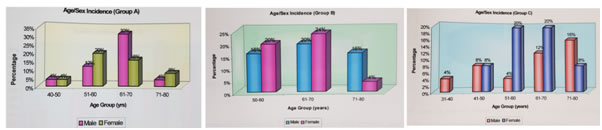
Graph 1: Age/Sex Incidence in Group 1; Graph 2: Age/Sex Incidence in Group 2; Graph 3: Age/Sex Incidence in Group 3

Graph 4: Incisions; Graph 5: Prevalence and Types of Pre – Operative Astigmatism
Table 1: Pattern of Post-Operative Astigmatism in Relation to Incision
|
Ab Externo Incision |
Selero orneal Valve Incision |
Clear Corneal Valve Incision |
Types of Astigmatism |
1stweek |
3rdweek |
6thweek |
1stweek |
3rdweek |
6thweek |
1stweek |
3rdweek |
6thweek |
|
no |
% |
no |
% |
no |
% |
no |
% |
no |
% |
no |
% |
no |
% |
no |
% |
no |
% |
With the rule |
9 |
36 |
8 |
32 |
8 |
32 |
8 |
32 |
5 |
20 |
5 |
20 |
5 |
20 |
5 |
20 |
5 |
20 |
Against the rule |
13 |
52 |
14 |
56 |
14 |
56 |
15 |
16 |
18 |
72 |
18 |
72 |
19 |
76 |
19 |
76 |
19 |
76 |
Oblique |
3 |
12 |
3 |
12 |
3 |
12 |
1 |
4 |
1 |
4 |
1 |
4 |
0 |
0 |
0 |
0 |
0 |
0 |
No Astigmatism |
0 |
0 |
0 |
0 |
0 |
0 |
1 |
4 |
1 |
4 |
1 |
4 |
1 |
4 |
1 |
4 |
1 |
4 |
DISCUSSION
Although the ophthalmic surgeon has been concerned with postoperative corneal astigmatism, because it is an integral part of the postoperative refractive error, there has been much confusion in explaining the pathophysiology of post operative changes in corneal curvature. Koch‘s study 2 on cadaveric eyes concluded that “corneal astigmatism is directly proportional to the cube of length of incision and inversely proportional to the distance of the incision from the limbus”. This is illustrated in the concept of the incisional funnel. The incisional funnel is an imaginary pair of curved lines representing the relationship between astigmatism and incision length. The lines diverge from the limbus, separating as the distance from the limbus increases. Short incision, may be made close to the limbus while longer incision have an equivalent effect only ifplaced far away from the limbus. With the introduction of corneoscleral sutures and improved methodfv of performing and closing the incision, the degree of postoperative astigmatism has declined dramatically. It was found in 1936 by GroenholmJ and Kangasniemi that ‘against the rule’ astigmatism was reduced by increasing the number of corneoscleral sutures. 10-0 monofilament nylon sutures were proved to have a fine control over postoperative astigmatism and wound closure. In an effort to reduce the progression of against the rule astigmatism. 10-0 monofilament polypropylene sutures and 10-0 monofilament polyester (mersiline) sutures were introduced because they remain in the eye for longer time before undergoing degradation than silk sutures. Modification and control of the astigmatism has been a long-term goal of ophthalmologists. The newer techniques are mainly aimed to reduce postoperative astigmatism. The advent of improved instrumentation (Phacoemulsification, improved blades, better sutures and needles) as well as; better preoperative and intra-operative measurement of astigmatism, have led to series of improvements, which promises to solve or greatly reduce the problem of induced astigmatism following cataract surgery, in the majority of the patients.
CONCLUSION
Against THE Rule Astigmatism was the more common type of Astigmatism and the oblique Astigmatism was the most uncommon.
REFERENCES
- Albert and Jak Obiec : Principles and practice of ophthalmology.
- Steincrl, Cataract Surgery
- Jaffe. Cataract Surgery and its complications
- 4.;%11k0 Elders 1970, System Of OPhthalmology Vol. V. Ophthalmic optics and refraction.
- Corneal astigmatism Troutman
- Be11uci R. et al. 1996 “Corneal topography and astigmatism after superior sutured 8mm scleral tunnel incision” J cataract Refractive Surgery 1996 July Aug. 22 (6): 690-5.
- Roman S. Givort G. Ullern M, 1997 “Choice of site of incision for cataract surgery withogt suture according to preoperative astigmatism” J. Fr. Ophthalmology 1997: 20 (9)673:9.
- Anders N., et al. 1997, ‘Post-operative astigmatism and relative strength of tunnel incision, a prospective clinical trial” J cataract Refractive Surgery 1997 Apri123 (3): 332-6.
- Oshika T et a1. 2000 “Regular and irregular astigmatism after superior versus temporal scleral incision cataract surgery” Ophthalmology Nov. 2000: 107(11): 2049-53.
- Lyme N. Hansen TE, Corydon L., 1998 “Relation between preoperative axis of astigmatism and postoperative astigmatic changes after superior scleral incision”, J Cataract Refractive Surgery, 1998 July 24 (7): 935-9.
 Home
Home
 This work is licensed under a Creative Commons Attribution-NonCommercial 4.0 International License.