 Home
Home
|
Table of Content - Volume 13 Issue 3 - March 2020
Implications of pseudoexfoliation syndrome in cataract surgery and its complications
Mohit Vishwakarma1*, M B Dongre2
1Junior Resident-II, 2Professor and HOD, Department of Ophthalmology, SRTRGMC, Ambajogai, Beed, Maharashtra, INDIA. Email: mohitvishwakarma9@gmail.com
Abstract Background: Pseudoexfoliation is a systemic syndrome of multifactorial origin affecting elderly people by increasing the risk of cataract and secondary glaucoma development. It is an age-related systemic disease having ocular manifestations. It is characterized by deposition of whitish fluffy amyloid like proteinaceous material in eye. Common sites of its deposition are the anterior chamber and its angle, trabecular meshwork, anterior surface of iris, anterior capsule of lens and sometimes cornea. Deposition of PES material on ciliary zonules leads to their weakening and instability. This can lead to subluxation or dislocation of lens causing phacodonesis. Patients with PES have significantly higher risk of variety of complications during cataract surgery which include small pupil, zonular dehiscence, posterior capsular rent. Despite modern techniques and technologies for cataract surgery, pseudoexfoliation syndrome represents a challenge for surgeons. Using currently available surgical devices, the risk of intraoperative complications may be much reduced, allowing the surgeon to handle difficult cases with larger margin of safety. This review analyzes the methodologic approach to the patient with PES the aim of providing useful advices to limit the risks of intraoperative and postoperative complications. Key Word: pseudoexfoliation syndrome.
INTRODUCTION Aims and Objective:
MATERIALS AND METHOD:
Inclusion Criteria:
Exclusion Criteria:
Patients will be selected according to the inclusion and exclusion criteria. After taking informed consent and reassuring patients regarding expertise and confidentiality Detailed history will be taken regarding demographic factors, occupation, previous medical, surgical and ocular history. Examination will done including general physical examination. This cross-sectional descriptive study was carried out on 50 eyes of 50 patients with cataract and PXE who underwent SICS or phacoemulsification surgery in a tertiary care hospital. There preoperative and intratraoperative and postoperative complications with visual outcome were documented and analyzed.
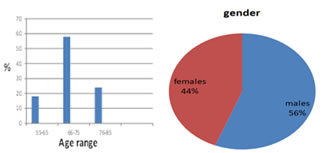
OBSERVATIONS AND RESULTS Fifty eyes of 50 patients with PXE who underwent cataract surgery by SICS or phacoemulsification technique were included in this study to evaluate the perioperative and post-operative complication. The ages of the 50 patients in this study was between 55 and 85 years. Out of these 8 (18%) were in 55-65 years age group, 28 (58%) patients were in 66-75 years age group and 14(24%) patients in were in 76-85 years age group. 28 (56%) were male and 22 (44%) were female.
Table 1: Pupillary dilation
None of the eyes showed frank subluxation of lens. All patients underwent cataract surgery using SICS technique or phacoemulsification. Surgical complications are listed in Table 1. Thirteen cases (25%) required sphincterotomy to facilitate capsulorhexis and nucleus delivery. Four eyes (7.69%) had vitreous loss due to difficulty in surgical manoeuvres. All four patients with vitreous loss were given anterior chamber lenses after doing anterior vitrectomy. Table 2: Intraoperative complications
Patients were followed on the post-operative day 1, day 7, day 14 and at monthly intervals for 3 months to evaluate intraocular pressure spikes, increased intraocular inflammation, decentration/tilt of intraocular lens and corneal decompensation. Post-operative hazy cornea was seen in 12 (23%) cases. Six cases (11.5%) had significant intraocular inflammation. The IOP was measured both pre-operatively and postoperatively. We did not find any pressure spikes in any patient. Final visual acuity was recorded after 6 weeks of surgery [Table 2].
Table 3: Post-OP visual acuity
CONCLUSION Inadequate pupil dilatation, and zonular weakness are the common difficulties associated with small incision or Phacoemulcification cataract surgery in eyes with pseudoexfoliation syndrome. Careful surgical evaluation and communication with the patient regarding increased surgical risks should be given in patients with Pseudoexfoliation syndrome. Early diagnosis, detailed ocular examination, beforehand preparedness for and management of intraoperative surgical complications and postoperative outcome associated with pseudoexfoliation improves surgical outcomes.
REFFERENCES
Policy for Articles with Open Access
|
|
 This work is licensed under a Creative Commons Attribution-NonCommercial 4.0 International License.