 Home
Home
|
Table of Content - Volume 13 Issue 3 - March 2020
A study of paediatric ocular injuries
Harish Shetty
Associate Professor, Department of Ophthalmology, Karwar Institute of Medical Sciences, Karwar, INDIA. Email: doc.hari12@gmail.com
Abstract Background: The first and the second decade of life ocular trauma forms about 20–50% of all eye injuries approximately 8–14% of total injuries in children below 10 years of age. Forty to sixty thousand of eye injuries lead to visual loss. Despite its public health importance, there is relatively less population-based data on the magnitude and risk factors for ocular trauma, especially from developing countries. Trauma to the eye and ensuing visual disability is an important cause of preventable monocular blindness in the paediatric age group in India. The ensuing visual disability has significant emotional, psychological, and Socioeconomically impact on the individual person, family, and to the society as a whole.1 Policy decisions helpful in preventing this kind of trauma and improving the required trauma management services warrant an accurate estimate of the pattern of the ocular trauma in Indian population. Key Words: Paediatric, Ocular, Injuries, Clinical, Demographic.
INTRODUCTION Ocular trauma can be considered as a life long suffering and also devastating injury, which can be responsible causing disability for a lifetime in children. This is one of the most important and common factor for loss of vision.1 Globally 5 lakh injuries occur every year.2 This is the reported numbers and there are also so many unreported cases. This may be easily one of the most important fields which has to be controlled. The total number of cases in India at present was reported as 2.4%.3 Throughout the world there are approximately 1.6 million people blind from eye injuries, 2.3 million bilaterally visually impaired, and 19 million with unilateral visual loss.4 It is also very preventable, perhaps a little care would make sure of the prevention of the injuries.5 The first and the second decade of life ocular trauma forms about 20–50% of all eye injuries6 approximately 8–14% of total injuries in children below 10 years of age.7 Forty to sixty thousands of eye injuries lead to visual loss.8 Despite its public health importance, there is relatively less population-based data on the magnitude and risk factors for ocular trauma, especially from developing countries.9 Trauma to the eye and ensuing visual disability is an important cause of preventable monocular blindness in the paediatric age group in India. The ensuing visual disability has significant emotional, psychological, and Socioeconomically impact on the individual person, family, and to the society as a whole.10 Policy decisions helpful in preventing this kind of trauma and improving the required trauma management services warrant an accurate estimate of the pattern of the ocular trauma in Indian population.11 Most of our understanding of this issue is based on the studies from developed countries12,13,14
AIMS AND OBJECTIVES To evaluate the paediatric ocular injuries.
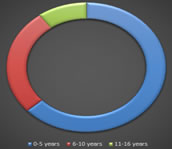
MATERIALS AND METHODS This study was done in the Department of Ophthalmology, Karwar Institute of Medical Sciences. This study was done from August 2019 to Jan 20. This study was done by observing 30 patients that we treated in the Department. Inclusion Criteria: Patients below 16 years Exclusion Criteria: Past ocular pathology. Patients on immunosuppressant and anticancer treatment. RESULTS Graph 1: Age Distribution
Table 1: Materials causing the Injury
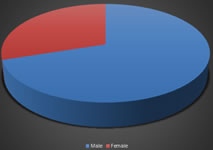
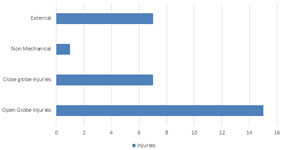
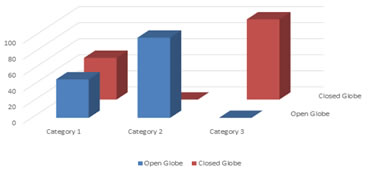
Table 2: Zone of Injuries According to BETT (Birmingham Eye Trauma Terminology) Graph 4 DISCUSSION Eye injuries per Birmingham classification (Birmingham Eye Trauma Terminology) BETT are divided into closed and open eye injuries.15,16.. Zones of injuries for closed globe injury (based on location of injury)- Zone 1: external (limited to bulbar conjunctiva, sclera and cornea) Zone 2: anterior segment (including posterior lens capsule including pars plicata) Zone 3: posterior segment (all internal structures posterior to the posterior lens capsule). When our study was compared with other studies. Age- in our study majority were in between 6-10 yrs. (42%), in Rohit Saxena et al..31 Study 5 years and older (87%) and in Saha et al.32 6-10 yrs. (47%). Sex- majority were boys in our study 68% which is comparable to Rohit Saxena et al.31 63% and Saha et al.32 63% studies. Type of injury-in our study 34% and 33%, in Rohit Saxena et al.31 53% and 42% and in Saha et al.32 53% and 32% open and closed globe injury respectively. Object causing injury-stick is most common object causing injury in our study. bow and arrowand sharp objects in Rohit Saxena et al.31 and Saha et al.32 studies respectively. Place of injury- playground/outdoor is most common place in ours and above two studies. The role of ocular injuries secondary to head trauma in the causation of blindness has become a subject of immense importance. TBI leads to neurocognitive deficits such as impaired attention, inability to perform visuospatial associations and psychological health issues. TBI is considered a silent epidemic as society is unaware of magnitude of the problem. The manifestations of head injury and its numerous other systemic complications are so compelling that damage to the visual system is most likely to be ignored. Many a times, when the eye is examined as part of neurological assessment of a patient with head injury, the purpose is mainly to gauge the severity of the head injury itself. Many hypotheses have been advanced to explain the cause of head injuries, but most of these hypotheses have remained untested and unproven. When we compare with other study the following can be compared.
CONCLUSION This is the most common and preventable type of injury. So utmost important should be given to this field by educating people and also prompt treatment should be initiated as soon as the patient lands in the OPD.
REFERENCES
Policy for Articles with Open Access
|
|
 This work is licensed under a Creative Commons Attribution-NonCommercial 4.0 International License.