 Home
Home
Official Journals By StatPerson Publication
|
Table of Content - Volume 10 Issue 2 - May 2019
Relationship between maternal haemoglobin and neonatal birth weight
Ajinkya Rupnar1, Sara Dhanawade2*
1Resident, 2Professor and HOD, Department of Paediatrics, Bharati Vidyapeeth Deemed to be University Medical College and Hospital, Sangli, Maharashtra, INDIA. Email: ajinkyarupnar11@gmail.com
Abstract Background: The birth weight of an infant is the most important determinant of its chance of survival health growth and development. The prevalence of low birth weight (LBW) is higher in Asia than elsewhere. Low birth weight is a major determinant of mortality, morbidity and disability in infancy and childhood and has a longterm impact on health outcomes in adult life. Objective: To assess the relationship between maternal hemoglobin concentration with neonatal birth weight. Material and methods: This retrospective study, was undertaken at Bharati Vidyapeeth Deemed university Medical College and Hospital, Sangli, for duration of 6 month (July 2018-December 2018) Relevant data of mother and baby pair was obtained from medical record department. Results: There was significant correlation between maternal haemoglobin and neonatal birth weight (pvalue<0.01, R value-0.25). Among low haemoglobin group, LBW was most common with m aternal haemoglobin <11 g/dl. However maximum LBW babies were under group with maternal haemoglobin 14-16 g/dl. Conclusion: There was significant correlation between maternal haemoglobin, birth weight and gestational age. The trend shows decrease in birth weight with maternal haemoglobin >14 g/dl, should caution us regarding the use of iron supplementation in mothers with haemoglobin above 14g/dl. Key Word: Maternal, Hemoglobin, Neonatal, Birth weight.
INTRODUCTION The birth weight of an infant is the most important determinant of chance of survival, growth and development. The prevalence of low birth weight (LBW) is higher in Asia than elsewhere. Low birth weight is a major determinant of mortality, morbidity and disability in infancy and childhood and has a long term impact on health outcomes in adult life.1 According to WHO, “babies with a weight of 2,500 grams or less should be designated as low birth-weight babies. Birth weight is a strong indicator not only of the mother’s health and nutritional status but also of the new-born’s chances for survival, growth, long-term health and development.1,2 Globally an estimated 15% of births result in low birth weight babies, whereas in India prevalence of low birth weight babies is 21.5%.3,4(NFHS-3) Low birth weight babies includes preterm and small for gestational age babies3. Majority of LBW in India are small for gestational age babies. LBW is major cause of infant mortality and is considered as a sensitive index of nation health and development. The low birth weight neonates are predisposed to a number of neonatal problems like hypothermia, inability to suckle the breast, asphyxia, sepsis, infection, hypoglycemia etc. Intrauterine growth is now considered an important determinant of both short and long-term outcomes for an individual.3,4 Maternal anaemia is one of the important factor that influences birth weight. There is striking association of birth weight with haemoglobin concentration, both low and high Hb concentration show adverse effect. The relation of haemoglobin concentration to birth outcome will probably depend on when the haemoglobin is measured, although this has not been fully described5. The normal haemoglobin concentration in the women is between 12-14 gm/dl. During pregnancy, plasma volume increases by 50 per cent and there is a consequent fall in Hb concentration, haematocrit and red cell count because of haemodilution. This is referred as physiological anaemia of pregnancy1. According to WHO anaemia in pregnancy is defined as haemoglobin level below 11g/dl. Anaemia is classified as mild when haemoglobin concentration is between 10-10.9 g/dl,moderate when between 7-9.9g/dl and severe when haemoglobin below 7 g/dl1.This study was aimed to evaluate the correlation between maternal haemoglobin and neonatal birth weight.
MATERIAL AND METHOD This retrospective study, was undertaken at Bharati Vidyapeeth Deemed university Medical College and Hospital, Sangli, for duration of 6 month (July 2018-December 2018). Relevant data of mother and baby pair was obtained from medical record department. Exclusion criteria
Analysis of Data: Statistical analysis was done by using SPSS-22. Statistical significance was evaluated using Chi-square test and Pearson correlation, Z test. The p value <0.05 was considered statistically significant. RESULTS 194 mother baby pair meeting inclusion criteria during study period were included. Table 1: Baseline characteristics of the study
Most of women were between age group of 19-25 years (69%) followed by 26-30 years( 26%) and 30-35 years(5%). Out of 194 delivery, LSCS (62%), vaginal delivery (37%) and instrumental (1%). Majority (85%) of babies were term and 15 % babies were preterm. Majority of newborn with birth weight >2.5 kg (55%) followed by LBW(45%).
Table 2: Distribution according to Degree of Anaemia
Among 194,55% mothers had anaemia and 35% had mild anaemia,19% moderate anaemia and 1 % severe anaemia Table 3: Maternal haemoglobin concentration in relation to birth weight
Table 4: Maternal haemoglobin concentration in relation to gestational age
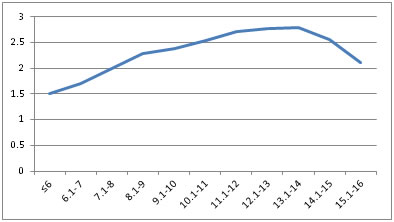
Table 3 and 4 showed there was significant correlation between maternal haemoglobin, birth weight and gestational age. Among low haemoglobin group, LBW was most common with maternal haemoglobin <11 g/dl. However maximum LBW babies were under group with maternal haemoglobin 14-16 g/dl. Graph 1: Relationship of maternal haemoglobin concentration with mean birth weight. There was increase in mean birth weight upto maternal haemoglobin of 14 g/dl and thereafter there was drop in birth weight with increase in haemoglobin. DISCUSSION In India prevalence of anaemia in pregnant women aged 15-49 years is 57.9%3,4(NFHS 3). Anaemia is most prevalent nutritional deficiency problem afflicting pregnant women . Anaemia complicates pregnancy and threatens the life of both mother and foetus. Traditionally anaemia was associated with suboptimal pregnancy outcome due to low birth weight. Birth weight is the single determinant of mortality in first year of life and good indicator of efficiency with which a women has supported her foetus.6 In present study, 194 mother baby pair were included. Most of mothers were between age group 19-25 years (69%). Eighty five percentage babies were term and mostly born by LSCS(62%).In our study, 35% mothers had mild anaemia, 19% moderate anaemia and 1% severe anaemia. Mean birth weight of newborn was 2.3+ 0.28 kg (range 1.50-2.79 kg). Nearly half (45%) of babies were low birth weight. Most of babies (75%) were discharged from postnatal ward, 22% required NICU admission and 3 % died. Beauty et al5 reported a higher percentage (65%) of low birth weight baby in these study. There was a significant correlation between maternal haemoglobin and neonatal birth weight (p value<0.01, r value-0.25) which were similar to studies done by Beauty et al 5, Leila et al 6and Philip et al 7.Among low haemoglobin group ,LBW was most common with maternal haemoglobin <11g/dl. However maximum low birth weight babies were under group with maternal haemoglobin 14.1-16g/dl. Beauty et al 5and Malhotra, et al8, also observed that the birth weight decreases with increase and decrease of maternal haemoglobin. Possible explanation for decrease in birth weight with low maternal haemoglobin level is due to decrease in oxygen delivery to foetus which results in intrauterine growth restriction and low birth weight babies.5 Similarly low birth weight in higher maternal haemoglobin is by failure in adequate plasma volume expansion or increased blood viscosity as a result of macrocytosis which leads to uteroplacental insufficiency and cerebrovascular complication. This, in turn, might adversely affect fetal growth.5 Polycythemia may be due to PIH, maternal diabetes, maternal smoking and maternal cyanotic heart disease6. We also observed that there was significant association with maternal haemoglobin and gestational age. (p < 0.02) which is similar to Philps et al7 study. On an average when maternal haemoglobin fell below 11 g/dl, the mean birth weight decreased by 0.192+ 0.64 kg. Similarly when maternal haemoglobin increased above 14 g/dl the mean change in birth weight was 0.5+ 0.212 kg in our study. Both these observations are highly statistically significant (p<0.00) In this study, maternal haemoglobin variation by 1g/dl, resulted in change of mean birth weight by 0.199 kg.Raman et al also reported change in mean birth weight by 0.3839 kg when maternal haemoglobin increased by 1 g/dl.
CONCLUSION There was significant correlation between maternal haemoglobin, birth weight and gestational age. The trend showing birth weight decreased by maternal haemoglobin above 14 g/dl,Should caution us regarding use of iron supplementation in mother with haemoglobin above 14 g/dl.
REFERENCES
|
|
 This work is licensed under a Creative Commons Attribution-NonCommercial 4.0 International License.