 Home
Home
Official Journals By StatPerson Publication
|
Table of Content - Volume 10 Issue 2 - May 2019
Epidemiological profile of obesity in mid school children
Vikas Narayan Solunke1, Yogita Gaikwad2, Shivprasad Mundada3*, Kiran Bhaisare4, Shital Bhattad5, Satyakala Garad6
{1,2,4Associate Professor, 3Professor And Head, 5Assistant Professor, Department of Pediatrics} {6Medical officer, Department of Ophthalmology} Government Medical College, Latur, Maharashtra, INDIA. Email: drvikassolunke@gmail.com
Abstract Background: Epidemiology of obesity in early adolescent is multi factorial and involves diverse interactions between genetic, metabolic, neuroendocrine, psychological, environmental and socio-cultural factors. Objectives: To see epidemiological profile of obesity in early adolescent children. Material and Methods: This cross-sectional study was planned to assess the prevalence of overweight, obesity in school children in early and mid adolescence in different schools in a city in Maharashtra, India and was carried out during August 2015 to July 2017. Five schools in a district of Maharashtra were selected with sample size of 2496. Descriptive statistics were expressed in Mean+SD, frequencies and percentages, correlation was studied using Pearson’s product moment correlation for data with normal distribution. Results: Among the students, 37.9% were of 13 years, 34.6% were of 12 years. Among the students, 57.8% were males while 42.2% were females. As per CDC classification, about 9.2% students were overweight while obesity was present in 4.4% students. A very strong agreement (κ=0.814) was found between the two classifications for overweight or obesity. No association was found between the presence of overweight or obesity and socioeconomic status, statistical significant association was found between the presence of overweight or obesity and type of diet consumed, junk food, salt intake and oil consumed. Conclusions: obesity and overweight was significantly associated with upper socioeconomic status, type of diet, junk food intake, salt consumption and oily food. Key Word: Obesity, BMI, Adolescents
INTRODUCTION In recent decades, there has been an unprecedented increase in the prevalence of overweight, obesity and hypertension among adolescents, in most of the countries, in both developed and developing alike.1–3 Owing to this increased occurrence, the health problems associated with these disorders in adults are also being frequently observed in adolescents.1,4 Body mass index (BMI) reflects the weight of an individual with reference to height. Many obese adolescents face psychosocial problems at schools and among friends, such as bullying, being laughed at, stigmatization, etc.1,3,5 During the initial years of adolescence, puberty hits, and, the adolescent undergoes many physiological changes owing to change in the hormonal levels. Coping up with these changes is quite stressful for them. Presence of obesity further complicates this scenario. Body dissatisfaction and weight concerns have been found to be more common in obese adolescents than those with normal weight.6–9 This perception of being obese, may result in psychological problems and affect the development of dietary behaviors, rather the actual weight of the individual.10–15 This can be overcome by prevention and treatment of increased weight among adolescents. Development of obesity among adolescents has several adverse physical consequences, such as increase in the cardiovascular risk factors like hypertension, dyslipidemia, hyper insulinemia, and impaired glucose tolerance. These may not present with any symptoms or signs in adolescence, but have been found to predict increase in mortality and morbidity in adulthood due to cardiovascular causes.16,17 Obese adolescents are predisposed to an increased risk of various systemic disorders of the pulmonary, neurological, gynecological, gastroenterological, orthopedic, hormonal disorders, etc.1,18,19 The present study was planned with an aim to observe the prevalence of overweight, obesity in the early adolescence in a district place in Maharashtra, India, to study the various associated factors.
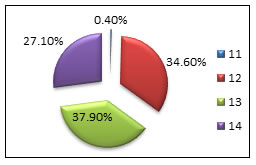
MATERIAL AND METHODS The present cross-sectional study was planned to assess the prevalence of overweight, obesity in school children in early and mid adolescence in different schools in a city in Maharashtra, India was carried out during August 2015 to July 2017. Fiveschools in a district in Maharashtra were selected randomly. In a study by Bharati et al20 in Wardha city in Maharashtra, the prevalence of overweight and obesity in school going children was 4.3% (p). Using formula, sample size = 4pq/l2, where, p =prevalence, q = 100-p, l = precision = 1 for type 1 error of 5%.Sample size = 4 x 4.3 x (100 – 4.3)/ (1)2= 4 x 4.3 x 95.7 = 1646. Thus, for the study, we need at least data on 1646 adolescents. Since, it is an epidemiological study, it was decided to include maximum number of adolescents from the 5 selected schools in 7th, 8th and 9th standard. At the end of data collection, the final sample size was 2496. Students of either sex in the 7th, 8th and 9th standards in school, aged >11 years but < 15 years and those students who gave informed assent, and whose parents or teachers gave informed consent were included and all those with any systemic diseases were excluded from the study. Teachers, students and their parents were informed about the study, in a language which could be easily understood by them. Informed consent from the teachers and parents, and from students. Height, weight and BMI was calculated using predefined and standard procedures. BMI was classified as Normal: BMI< 85th percentile Overweight: 85-95th percentile Obese: > 95th percentile. The data was analyzed using SPSS version 21 software. Descriptive statistics were expressed in Mean+SD, frequencies and percentages, correlation was studied using Pearson’s product moment correlation for data with normal distribution. The level of significance in the study was 0.05 (p<0.05). RESULTS Figure 1: Distribution as per age Among the students, 37.9% were of 13 years, 34.6% were of 12 years, 27.1% were of 14 years, while 0.4% were of 11 years. Among the students, 57.8% were males while 42.2% were females.
Table 1: Distribution of BMI as per CDC classification
As per CDC classification, about 9.2% students were overweight while obesity was present in 4.4% students.
Table 2: Agreement between CDC and IOTF BMI classification-
A Cohen’s kappa was run to assess the agreement between the classification of overweight or obesity as per CDC classification and IOTF classification. A very strong agreement (κ=0.814) was found between the two classifications for overweight or obesity.
Table 3: Association with socioeconomic status and BMI
Chi square = 3.774, df=3, p=0.856. On comparing the presence of overweight or obesity in students from different socioeconomic status using Chi square test, no association was found between the presence of overweight or obesity and socioeconomic status of students [χ2 (3) = 3.774, p=0.856].
Table 4: Association with consumption of type of diet
On comparing the presence of overweight or obesity with type of diet in students using Chi square test, a statistical significant association was found between the presence of overweight or obesity and type of diet consumed by students [χ2 (2) = 11.939, p=0.003].
Table 5: Association with intake of junk food
On comparing the presence of overweight or obesity with intake of junk food in students using Chi square test, a statistical significant association was found between the presence of overweight or obesity and intake of junk food by students [χ2 (3) = 8.134, p=0.043].
Table 6: Association with salt intake
Table 7: Association with oilintake
Table 8: Association with physical/sports activity
On comparing the presence of overweight or obesity with physical/sports activity in students using Chi square test, a statistical significant association was found between the presence of overweight or obesity and physical/sports activity by students [χ2 (4) = 56.217, p<0.001]. DISCUSSION Adolescent obesity is associated with increased risk of persistence in adulthood. In India, there is a lack of studies which demonstrate the correlation between the adolescent overweight or obesity. Hence, this study was planned with the objectives to evaluate the factors associated with prevalence of overweight or obesity in adolescents, and to assess, if any, association between various factors leading to obesity. The present study was conducted in a city in Maharashtra, India in early adolescents from 6 schools. Prevalence of overweight in early adolescents was 9.2% (as per CDC classification)/ 11.2% (as per IOTF classification). Prevalence of obesity was 4.4% (as per CDC classification)/ 7.4% (as per IOTF classification). Common factors associated with presence of overweight or obesity were consumption of vegetables, salt, oil, physical/sports activities, duration of daily sleep, mode of delivery, parental history of hypertension, and waist circumference. Additional factors associated particularly with presence of overweight or obesity were consumption of type of diet – vegetarian/nonvegetarian, junk food, and daily duration of sleep. Lang et al21 studied the BMI of the early adolescents in the age group of 12-17 years according to the CDC and IOTF criteria. As per CDC, reported prevalence of overweight or obesity in England was 24.4% and in US was 32.2%, while as per IOTF, it was 25.6% and 33.6%, respectively. This is much higher compared to that observed in the present study. This might be due to the type of diet consumed by the population in the respective countries. A higher prevalence was also noted in an Iranian study by Hajjan-Tilakiet al22, who reported it to be 25.5% in boys and 21.4% in girls as per CDC, and 26% in boys and 20.9% in girls as per IOTF. They found a strong agreement between the CDC and IOTF classification of 0.86 and 0.73 in boys and girls, respectively. In the present study, an overall strong agreement (κ=0.814) was found between the CDC and IOTF classification for determining overweight and obesity. Thus, either of CDC or IOTF can be used for assessing overweight or obesity in early adolescents. However, it should be noted and kept in mind that the reported prevalence by IOTF is slightly more than CDC. As per CDC, the prevalence of overweight and obesity in present study was 9.2% and 4.4%, respectively. In a systematic review by Bibiloni et al23, regarding prevalence of overweight in different regions in adolescents aged 10-19 years, it was 4.4-15.7% and 0.7-8.7% in Asia. The findings of the current study match the prevalence of overweight and obesity in the range of Asian countries stated by Bibiloni et al23. Vieno et al24 and Biro et al25. Among Indian studies, Maiti et al26 in West Bengal, reported prevalence of overweight and obesity to be 7.64% and 7.49% as per CDC and IOTF, respectively, and of only obesity, it was 1.74% and 1.31%, respectively in children aged 10-14 years. Kowsalya et al27 reported prevalence of overweight and obesity of 12.11%. Chandrakala et al28 reported CDC prevalence of overweight and obesity to be 7% and 4.2%, respectively. Thus, findings of the present study further adds to the variation, but lies in the range of prevalence in different studies in India. As observed in the lifestyle habits in the present study, intake of non- vegetarian diet was associated with high prevalence of overweight or obesity compared to the vegetarian diet. Further, those with less vegetable intake, more junk food intake, high salt intake, and high oil intake showed a higher prevalence of the overweight or obesity. This demonstrates the importance of dietary habits in the role of overweight and obesity. Also, increased physical activity or participation in sports was associated with decreased prevalence of overweight or obesity. Those sleeping daily in the range of 6-8 hours, which we consider as an optimal duration of sleep, had lower prevalence. While those sleeping in less than 6 hours and more than 8 hours had higher prevalence of overweight and obesity. Thus, less sleep and excess sleep both are associated with the weight abnormalities. Association of physical and sedentary activity with presence of overweight or obesity was observed by Vieno et al.24 Macieira et al29 found significant association of prevalence of obesity with food habits, exercise, family history, age and sedentary lifestyle with childhood obesity.
CONCLUSION The prevalence of overweight was 9.2% as per CDC classification and 11.2% as per IOTF classification. The prevalence of obesity was 4.4% as per CDC classification and 7.4% as per IOTF classification. There was a strong agreement in measuring the prevalence of overweight and obesity by CDC and IOTF classification. Associated factors with increased prevalence of overweight or obesity were intake of non-vegetarian diet, less vegetable intake, more junk food intake, high salt and oil intake, reduced physical or sports activity, excess or inadequate daily sleep duration and increased waist circumference.
REFERENCES
|
|
|||||||||||||||||||||||||||||||||||||||||||||||||||||||||||||||||||||||||||||||||||||||||||||||||||||||||||||||||||||||||||||||||||||||||||||||||||||||||||||||||||||||||||||||||||||||||||||||||||||||||||||||||||||||||||||||||||||||||||||||||||||||||||||||||||||||||||||||||||||||||||||||||||||||||||||||||||||||||||||||||||||||||||||||||||||||
 This work is licensed under a Creative Commons Attribution-NonCommercial 4.0 International License.