 Home
Home
Official Journals By StatPerson Publication
|
Table of Content - Volume 10 Issue 3 - June 2019
A cross sectional study to assess the knowledge and attitude of breast feeding among undergraduate students of medical college from central India
Pratibha Vinay Kale1, Satish Tiwari2, Pankaj Barabde3*, Pravina Kale4
1Associate Professor, 2Professor, 3Assistant Professor, 4Final MBBS Student, Department of Pediatrics, Dr. P.D.M.M.C. and R.C., Amravati, Maharashtra, INDIA. Email: drpvbarabde@gmail.com
Abstract Background: Human milk is not only a perfect nutrition but recent research has indicated that it may even exercise a degree of control over metabolism from cell division to infant behavior.(1) So a study of prevalent infant feeding practices is essential before formulation of any need based intervention program and to outline trends in feeding patterns.(2) Methods: It was cross sectional observational study conducted among undergraguate students from Dr. P. D. M. Medical College and Research Center. Result: 64%from 1st year and 88% from 3rd year were against to give prelacteal feed(P<0.05).For initation B.F. witin 1st hour after delivery 29%from 1st yearand 63% from 3rd year were in favour(P<0.05).78%-85% from 1st to 3rd year stated colostum is sufficient.7% from 1st year and 55% from 3rd year were of opinion that home available food used for C.F.(P<0.05).41% from 1st year and 83% from 3rd year thought that total duration of B. F. should be between 12-24 months(P<0.05).54% students from 1st year and 87% students from 3rd year said no to habit of bottle feding for giving top milk(P<0.05). 94%-96% from 1st year to 3rd year were of opinion that there is need of B.F. awareness programme. Conclusion: There was a gross difference in opinion among 1st year and final year students indicating that medical curriculum definitely changes knowledge and attitude regarding B.F by giving education to them. As students (10%-15%were ready for exclusive B.F) facing dilema regarding H.I.V. and B.F. practices. This issue needs more emphasis regarding health education as well as making a policy. In our study maximum students (70 – 90%) were unaware of the I.M.S. act 1992 should be included in medical education to protect, promote and support B.F. Though there is a general awareness in B.F. knowledge and practices is far away from satisfactory. Key Word: Bottle feding, Breast feeding (B.F), colostrum, complementary feeding (C.F.), I.M.S. act, prelacteal feed and undergraguate students.
INTRODUCTION The value of mother’s milk in infant feeding has been raised in India over two thousand years as emphasised in ‘Charak Samhita’, “Jeevanam Bruhanam Satmayam Snehanam Manusham Payah”, Charak Sutra Stnanam 27/224. In our country education and socio-economic status have not made much different as far as acceptance and practice of breast-feeding is concerned with several but wrong practices being continued.3 In the educated mother the formal education they had didn’t influence the initiation of breast-feeding. They depend more on tradition and advice of elder’s.4 Deep rooted traditions passed from generation to generation prevent rational thinking in educated elite.5 Karnawal et al6 have shown that only 2% of doctors know the significant advantages of breast-feeding. (Contraception, uterine involution and prevention of breast-cancer The Unethical and Aggressive marketing strategy adopted by the manufacturers of Infant Milk Substitutes (IMS) and feeding bottles. The “Infant Milk Substitute, Feeding Bottles and Infant Foods Act (Regulation of Productions, Supply and Distribution) Act 1992” which prohibits the advertisement and promotion of feeding bottles and infant milk substitute by unethical marketing strategies came into force from 1st Aug. 1993.7 As nutritional status of infant depends on feeding practices prevalent in community2, it is important to frequently monitor the changing trends of infant feeding practices. Material AND Methods It was cross sectional observational study conducted in Dr. P. D. M. Medical College and Research Center. Undergraduate students surveyed were 300 out of which from 1st, 2nd and 3rd were 76, 104 and 120 respectively. It consists of name of the student, name of the college, year in which student is studying and questionnaire related to B.F and C.F. To start with questionnaire was designed to cover up maximum common concept regarding B.F. like prelacteal feeds, colostrum, time for initiation of B.F, total duration of B.F, habit of bottle for giving top feeding diet of lactating mother, IMS act, B.F. awareness program, HIV and B.F. Before solving the proforma all questions were explained to the students. Data was analysed in Microsoft excel and percentage was calculated. Suitable test of significance applied.
OBSERVATIONS AND RESULTS Table 1: Knowledge of Students Regarding Breast Feeding
64% from 1st year and 88% from 3rd year students said no to prelacteal feed, improvement in knowledge from 1st to 3rd year and it is significant. (p<0.005). 54% from 1st year and 87% from 3rd year students said no to bottle, improvement in knowledge and it is significant (P<0.005) Figure 1: Initiation of first Breast-feeding in Normal Delivery
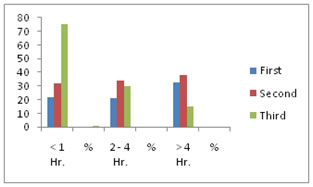
22% from 1st year and 75% from 3rd year are of opinion that start B.F. <1 hour and it is statasticlly significant (p<0.005) Table 2: When Water Should be Offered to Baby
Table 3: C.F. Should be Started at What Age
Figure 2: Type of Food for C.F. 7% from 1st year and 55% third year are ready for home available food and it is significant (p<0.005)
Table 4: Total duration of B.F.
54%from 1st year and 69% from 3rd year students are in favour of 12 to 24 months and it is significant (p<0.005)
Table 4: Total duration of B.F.
54%from 1st year and 69% from 3rd year students are in favour of 12 to 24 months and it is significant (p<0.005)
Table 5: Whether Balkadu / Gripe Water / Dental Tonics Are
Table 6: In H.I.V. +ve Mother and H.I.V. -ve Baby Should get
10% students from 1st year and 15%fom 3rd year in favour of giving exclusive B.F,
DISCUSSION Table no.1 shows that almost 88% of students from 3rd year MBBS, were of opinion that prelacteal feed should not be given. But 64% of 1st year MBBS, students were in favour of giving prelacteal feeds. From the above table it is seen that there is difference in opinion of 1st and 3rd year of students and it is statistically significant (P<0.05) indicating that gradually with the medical education their knowledge regarding the proper B.F. practices is improving. A Gupta and R Gupta (1989) surveyed 100 mothers with babies below 4 months. Breast milk was the first feed in 2% infants, honey in 90%, glucose water in 5% and jaggery, sugar-salt water in 1% each. Most of the exclusively breast fed infants, had received some other feed before establishing a status of exclusively breast-feeding8 In fig. no.1 there is difference in opinion between 1st year and 3rd year students of MBBS almost 22% of 1st year students and 75% of 3rd year students wanted to start the B.F within 1 hour of birth. This is statistically significant (P<0.05), indicating that knowledge regarding B.F. is improving from 1st year to 3rd year. G. N. Prabhakar et al (1987)9 studied 1055 families living in slums of Bangalore. The mothers starting breast-feeding within 4 hours, 4 – 12 hours, 12 – 24 hours, 1– 4 days and more than 4 days were 19.48%, 21.2%, 41.7%, 14.1% and 3.5% respectively. But 85% of students of 3rd year MBBS, were in favour that colostrum is sufficient. Among majority of Indian mothers, studied in various areas colostrum was considered to be harmful and was not given to the baby.10 The another study by V Vimla and C Ratnaprabha in the tribal of Andhra Pradesh observed 100% acceptance of colostrum.11 In table no.1 most of the students were of the opinion that excessive crying of baby does not always mean inadequate breast milk. Here again there is a difference in views of 1st year (75%) and 3rd year (94%) students and this is statistically significant. According to table no.2 significant % of students i.e. 37% from 1st year, 45%- 2nd year and 41%-3rd year were of opinion that water should be offered during 1 – 2 months and about 7-15% of students thought that it should be offered after 6 months. The survey conducted by H.P.S. Sachdeva12 on 70 doctors (20 senior residents and 50 junior residents) and 34 nurses in Delhi Hospital. All were aware of the superiority of breast milk. However 97% nurses and 63% doctors (P<0.0005) believed that water supplementation was necessary during summer. Of those who advocated water supplementation 6% nurses and 23% doctors suggested that water should be given on demand. The suggested frequencies ranged from 1 – 24 times a day for nurses and 2 – 10 times a day for doctors. Regarding the age of complementary feeding the concept of most of the students was wrong. The most common view was to start between 2 – 4 months.BNS Walia et al (1974 – 84)13 observed that the addition of semisolid to the diet of infant aged upto 6 months increased from 16.2% to 46.3% among illiterate mothers. Our observations probably are the effect of this trend. As per fig no.2 the encouraging finding was 55 % of students from final year were of the view that home made food should be used. But still the significant % of students from 1st year and 3rd year MBBS, were in favour of giving baby food along with home available food. There was statistically significant difference in the opinion from 1st year to 3rd year students (P<0.05). As their knowledge regarding infant B. F. practices is improving from 1st year to 3rd year but they still need the health education regarding the use of only home available food and restricting the use of commercial food. G.P. Katiyar et al14 pointed out that delayed weaning and late introduction of solids and semisolids along with adverse beliefs regarding food items were added hazards to the health and well being of the children. The study revealed that most of the children of the urban slum and rural area were not given cereals, meat, etc. during infancy. As per table no4, 54% of students from 1st year and 69% from 3rd year MBBS, were in favour that the total duration of B.F should be between 12 – 24 months and is statistically significant (P<0.05). About 17%, 17%, 18% from1st, 2nd, 3rd year students were of opinion that total duration of B.F. should be 24 months or more. Kumar et al (15) found that 68.4% mothers wanted B.F. to continue till the baby wanted, 11% for more than two years and 12.7% for one – two years. Table no.1shows 54% of 1st year and 87% of 3rd year MBBS, students thought that bottle should not be used. The awareness in the 3rd year students regarding the habit of bottle is better than the 1st year and the 2nd year students (P<0.05), and is probably because of medical education regarding B.F. and avoidance of bottle feeding. A Gupta and R Gupta studied 100 mothers with following observations. In group I, antenatal advice was given 13% only through all mothers attended ANC OPD Bottle-feeding was used at one or another time in 90% infants.8 In group II, of the 100 mothers interviewed, antenatal checkup was done in all but only 11% mother received advice regarding breast-feeding. However after campaign against bottle-feeding, 60% mothers got postnatal information on advantages of breast-feeding and dangers of bottle-feeding. Prevalence of artificial feeding was 56% (54% were fed with bottle and 2% with spoon). The commonest reason (70% of bottle fed group) for giving supplementary feeds was to get the child used to bottle, he may refuse it later on. Insufficient breast milk was the other reason in about half of the cases. The advice to give bottle feeds was received by mothers from doctors in 25 cases, nurses in 20 cases and grandmother in 16 cases. In 6 cases the decision was that of the mothers.8 GP Mathur and PK Pande studied 615 newborns in 7 nursing home 52.4% mothers (45.1% mixed feed and 7.3% bottle fed) were given infant formula.16 Table no.5 shows that 45% of 1st year and 73% of 3rd year MBBS students thought that balkadu gripe water and dental tonics are not necessary. There is improvement in knowledge of 1st year to 3rd year students and is statistically significant (P<0.05). But still 10 – 20% of 3rd year students were in favour of giving balkadu, gripe water and dental tonics. Thus the health education regarding this aspect is essential. Table no.1 shows 24% 1st year and 73% of 3rd year, students were of opinion that there should be no restriction of diet for lactating mother. There is improvement in knowledge from 1st year to 3rd year students because of medical education. Table no.6 shows almost 70 – 80% of students from 1st year, 2nd year and 3rd year MBBS, were of opinion that H.I.V.+ve mother and H.I.V –ve baby should get artificial feeding. Only 10–20% of students were in favour of exclusively B.F. the baby in H.I.V. +ve mother and H.I.V. –ve baby. Position statement on H.I.V. and infant feeding states that: The general principle17 “Irrespective of H.I.V. infection rates, breast-feeding should continue to be protected, promoted and supported” should be followed. Table no.5 shows almost 95% students thought that there is a need of health education program for breast-feeding awareness in India. Table no.1 shows 70 – 90% of students were unaware of I.M.S. act.
sUMMARY AND CONCLUSIONS After the survey of 300 undergraguate medical students, there is a gradual improvement in knowledge regarding giving prelacteal feed, colostrum, giving Balkadu / Gripe Water / Dental Tonics, water should be offered after 6 months, starting complementary food, total duration of Breast feeding, habit of bottle for giving top milk, restriction in lactating mother's diet from1st year to 3rd year students because of medical education and it is significant. It seems that all these concepts are deep rooted, much need to be done to improve knowledge regarding Breast feeding, discouraging wrong practices and encouraging healthy practices by giving education to students in their medical curriculum. Inspite of advertisement of baby food on large scale encouraging finding is that 3rd year students were in favour of giving home available food for complementary feeding. H.I.V. is a measure health problem, in our study almost 70 – 80% of students were in favour of giving only artificial feeding to such babies. As mothers, health workers facing with dilemma concerning the infant feeding regarding H.I.V. and B.F. practices. This finding is very important because the final year students are equivalent to medical practitioners, as they will be going as intern practicing in the field. This issue needs more emphasis regarding health education as well as making a policy, which can be followed with clear recommendation. In our study regarding need of health education program for B.F. awareness in India almost 95% students were in favour of such programs, so as to give scientific and correct information regarding B.F. In our study maximum students (70 – 90%) were unaware of the I.M.S. act 1992. Most of the students from final year usually know about MTP act, CP act, etc as this is covered in Gynecology and Forensic Medicine, but they did not know this act. Thus this act should be included in medical education to protect, promote and support breast-feeding. Though there is a general awareness in B.F. knowledge and practices is far away from satisfactory.
REFERENCES
|
|

 This work is licensed under a Creative Commons Attribution-NonCommercial 4.0 International License.