 Home
Home
Official Journals By StatPerson Publication
|
Table of Content - Volume 11 Issue 1 - July 2019
Auditing the prescriptions of doctors in the management of acute diarrhoea in children under 5 years - A hospital-based study
Lata Jha1*, Sonu Akhani2, Phalguni Chatterjee3
1Senior Resident, 2Assistant Professor, Department of Pediatrics, BJ Medical College And Hospital, Ahmedabad, Gujarat, INDIA. 3Senior Consultant, Department of Pediatrics, Bokaro General Hospital, Bokaro steel city, Jharkhand, INDIA.
Abstract Background: Diarrhoea is one of the leading causes of mortality and morbidity in India. Most of the cases of diarrhoea in under- five children is self-limiting. The evaluation of current practices by primary care paediatricians regarding management of diarrhoea is needful as we are fighting against antibiotic resistance. Objectives: To assess the use of antibiotics in acute diarrhoea by doctors in peripheral centres and to evaluate the implementation of zinc and ORS supplementation. Methods: A hospital based cross-sectional study was done in inpatient ward of Paediatrics department at Bokaro General Hospital from 15th October, 2013 to 15th September 2014 in children aged 1 month to 5 years presenting with acute diarrhoea. Data regarding demographic profile, the severity of disease and associated symptoms were assessed. The prescriptions were reviewed, the profile of doctors and drugs used were recorded. Instructions given to the patients, both written and oral, especially regarding preparation and administration of ORS was assessed. Children suffering from systemic infections and dysentery as well as those who were malnourished were excluded from the study. Results: A total of 253 prescriptions of patients with acute watery diarrhoea were analysed. Paediatricians were consulted in 73.5% (186) cases. Antibiotics were prescribed in 71.5% (179) cases of acute diarrhoea; 63.9% of paediatricians and 89.5% of general practitioners prescribing antibiotics. Ofloxacin and metronidazole were preferred choices. Zinc was given in 71.7% (180), ORS in 97.2% (246), and nutritional advice given in 12.6%(32) cases. Antisecretory agent was given in 15.4% cases (39). Conclusion: In spite of guidelines by WHO and IAP, several irrational drugs are being prescribed by doctors. Steps should be taken to decrease irrational use of antibiotics in acute diarrhoea to stop development of antibiotic resistance and decreasing health expense of patients. Appropriate use of ORS and zinc should be encouraged. Key Word: antibiotics, diarrhoea, ORS, zinc.
INTRODUCTION Diarrheal disease is the second leading cause of death and leading cause of malnutrition in children under five years old according to World Health Organization (WHO). It is both preventable and treatable. Each year diarrhea kills around 525 000 children under five. A significant proportion of diarrheal disease can be prevented through safe drinking-water and adequate sanitation and hygiene. Globally, there are nearly 1.7 billion cases of childhood diarrheal disease every year. Most cases of diarrhea in under-five children are caused by viruses and is self-limiting. WHO has recommended evidence-based cost-effective interventions limiting the treatment to use of zinc, oral rehydration salt solution (ORS) and nutritional advice and use of antibiotics only in malnourished children, dysentery, persistent diarrhea and septicemia. In spite of this, doctors from both public sector and private set ups end up prescribing antibiotics in acute diarrhea. A study by Sharma et.al. showed prescription of antimicrobials in 29.22% and ORS in 82% cases by pediatricians1. Another study by Devi et al. showed adherence of government tertiary care hospital to WHO guidelines in 83% while private tertiary care, government secondary care and private care hospitals not adherent to the guidelines2. The emerging antibiotic resistance augments the need of not only proper antibiotic use but also creating awareness and confidence regarding this among peripheral doctors. This study also aims at education regarding counselling of ORS formulation, intake and nutritional advice.
MATERIALS AND METHODS Study Design: A hospital based cross-sectional study was done in inpatient ward of Paediatrics department at Bokaro General Hospital, Jharkhand, India. Study Duration: From 15th October, 2013 to 15th September 2014 Inclusion Criteria: Children aged 1 month to 5 years presenting with acute watery diarrhea who had consulted other doctors before admission and having previous prescriptions. Exclusion Criteria: Children with systemic infections, dysentery, cholera, and those with malnutrition. Relevant data was recorded. Statistical method: MS-EXCEL and SPSS-17 used for data analysis. P- value was calculated with the help of 2*2 contingency table by Fisher’s exact test.
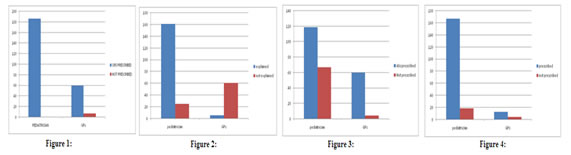
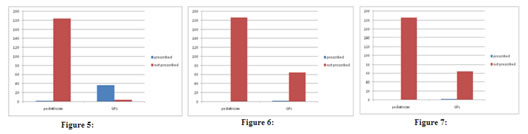
RESULTS AND DISCUSSION An audit of 253 patients of acute diarrhea whosoever had consulted some private practitioners before coming to our hospital was done.20.9%(53) of patients were less than 1 year of age, 36.3%(92) were between 1 to 3 years of age and 42.6%(108) cases were between 3 and 5 years of age. Median frequency of stool was 5/day. The average duration of hospital stay was 3.3 ±1.1 days. The associated complaints were vomiting in 159(62.8%), fever in 154(60.8%) and dehydration in 135[some dehydration in 126(49.8%) and severe in 9(3.6%)] cases. The average cost of treatment in private set-up was Rs.150-250 while it was free of cost in government institutes. Only 67 patients (26%) consulted General practitioners (GP) while 186(74%) consulted pediatricians. When prescribing ORS is concerned, all pediatricians prescribed ORS while 7 GP’s didn’t prescribe ORS. Among 186 pediatricians prescribing ORS, only 161(86%). explained how to prepare and administer it(Figure 1,2). The numbers were even more surprising in GP’s as only 6 out of 67 explained formulations. This result emphasizes that there is a need to create awareness among medical practitioners to not only prescribe ORS but also to explain its formulation as improper concentrations can increase the frequency of stools. Use of antibiotics is a serious issue in acute gastroenteritis. 119 cases (63.97%) by pediatricians and 60 cases (89.5%) by GP’s were prescribed antibiotics (Figure 3). The most commonly used antibiotics were ofloxacin-ornidazole and cefixim. Zinc helps in epithelization of gut and is an important component of management.167 cases (89.7%) by pediatricians and 13 cases (19.4%) by GP’s were given zinc orally (Figure 4). Probiotics were given to 179 cases (96.2%) by pediatricians and 40 cases (59.7%) by GP’s(Figure 5).Antisecretory agents were prescribed to 2 cases and loperamide to none by pediatricians while GP’s prescribed antisecretory to 37(55.2%) patients and loperamide to 2 cases(Figure 6,7). Diarrhea is the passage of loose and watery stools and is mostly viral in under- five children. WHO/UNICEF (2004) officially recommended reduced osmolarity oral rehydration salt (reduced ORS) solution and zinc supplement for the treatment of childhood diarrhea3, 4. Priyadarshini K. et. al. conducted similar study for effectiveness of WHO implementation of diarrhea management5.There was less irrational use of antibiotics and proper zinc and ORS administration in their institute. According to the studies by Howteerakul et al. and Singh et al., the percentage of patients prescribed on antibiotics were 72.6% and 64%, respectively. 6,7. This study was similar to our study as antibiotics were prescribed in huge numbers. Prakash et al.8 found that 28.4% of children were prescribed antibiotics and ORS in only 13.9% of under-6 children. Use of steroids was also observed in children in this study. Even an international study by Ekong E. Udoh suggested misuse of antibiotics9 This study was aimed at analyzing the use of antibiotics as well as proper use of ORS and zinc, including counselling regarding use of ORS and nutritional advice. Periodic training of health worker was advised and oral metronidazole was found to be most commonly used antibiotics. Tsakala TM et. al. analyzed prescriptions and found out irrational use of drugs in gastroenteritis.10 Thus, most of the studies supported the misuse of antibiotics in diarrhea. Our study too confirmed the same. In addition, underuse of ORS and zinc has been emphasized in our study. Use of agents like loperamide is a shocking reveal. Though this study doesn’t aim to criticize any medical practitioner, there is a definite need for introspection. As per H.R. Potharaju and S.G.Kabra11, audit of prescription is an important way to improve quality care provided by hospitals. This was the very purpose of our study.
Figure 1: Ors Prescription By Consultant (p value <0.0001); Figure 2: Ors Explained To Patients (p value <0.0001); Figure 3: Antibiotics prescription (p value <0.0001); Figure 4: Zinc prescription (p value <0.0001); Figure 5: probiotics prescription (p value <0.0001); Figure 6: Antisecretory prescription (p value <0.0001); Figure 7: loperamide prescription (p value 0.0694)
CONCLUSIONS Despite clear guidelines given by WHO and IAP regarding acute diarrhea in children less than 5 years, there has been irrational use of antibiotics. This might be due to parental anxiety. But as there is an increasing cases of antibiotic resistance, we need to be very judicious in prescribing antibiotics. An emphasis on ORS prescription, especially its formulation, should be made during treatment as this reduces a number of indoor admissions and mortality due to severe dehydration. Other aspects of care such as nutrition is much neglected as there is misconception in society that no feeds should be given during diarrhea. This adds on to malnourishment which in itself is a grave monster. Action plans and sensitization of medical community, patients and family members are necessary for implementation of medical treatment.
REFERENCES
|
|
 This work is licensed under a Creative Commons Attribution-NonCommercial 4.0 International License.