 Home
Home
Official Journals By StatPerson Publication
|
Table of Content - Volume 12 Issue 3 - December 2019
Foot length of newborn and its correlation with gestational age and various anthropometric parameters
Suresh Nana Waydande1, Madhavi Chintaman Sahastrabudhe2*
1Associate Professor, 2Assistant Professor, Department of Pediatrics, Prakash Institute of Medical Science & Research Urun-Islampur, Sangli Maharashtra, INDIA. Email: snwaydande1960@gmail.com
Abstract Background: Accurate assessment of gestation maturity is not possible in all newborn infants especially when they are sick and need intensive care support. Aims and Objectives : Foot length of newborn and its correlation with gestational age and various anthropometric parameters Methodology: This was a prospective observational study carried out in the all live birth babies at Prakash Institute of Medical Science and Research centre, Urun-Islampur (Sangli) Maharashtra, during the one year period i.e. June 2018 to May 2019 in the study period those parents given written and explained consent were included into the study and Babies born with lower limb congenital anomalies were excluded from the study. So during the one year period there were 121 newborns were examined by Birth weight (kg), Head circumference (cm), Chest circumference (cm), Foot length (cm) all these information entered to excel sheet and analyzed by linear regression equation calculated by excel for windows 10 software Result : At GA 28 weeks- 5.19±1.23, 24.79, 21.54, 0.975; 30 weeks- 5.87±1.45, 26.94, 23.89, 1.52; 32 weeks- 5.98±1.98, 27.28, 24.57, 1.67; 34 weeks- 6.31±2.87, 29.86, 27.54, 2.13; 36 weeks- 6.68±2.39, 31.57, 28.86, 2.68; 38 weeks- 7.12±1.63, 32.69, 29.58, 2.87; 40 weeks- 7.67±2.37, 33.89,29.98, 3.69; 42 weeks- 8.73±3.01, 35.74, 31.58, 3.98 respectively the FL (cm), HC(cm), CC(cm), BW(Kg) respectively. All parameters including GA were in linear equation with FL the equations of line and regression coefficients were GA (weeks) y = 4.231FL + 6.672, R² = 0.946; HC(cm) y = 3.262FL + 8.508, R² = 0.937; CC(cm) y = 2.884FL + 7.883, R² = 0.865 ; BW(kg) y = 0.919FL - 3.717, R² = 0.955. Conclusion : It can be concluded from our study that FL correlated significantly with GA, HC, CC, and BW hence it can be considered as proxy measures of other anthropometric measurement ,in the places where other anthropometric parameters are difficult to measure this simple measure is very useful for early detection of low birth weight , Intrauterine Growth Retardation (IUGR) etc. Key Words: Gestational age (GA) Birth weight (BW) (kg), Head circumference (HC) (cm), Chest circumference (CC)(cm), foot length (FL) (cm), Intrauterine Growth Retardation (IUGR)..
INTRODUCTION Accurate assessment of gestation maturity is not possible in all newborn infants especially when they are sick and need intensive care support. Anthropometric measures such as: birth weight, crown heel length and head circumference are the commonly used measures of growth in neonates, and they do correlate fairly with maturity. Weight measurements are significantly affected by changes in water, carbohydrate, fat, protein, and mineral levels. 1 Although head circumference reflects brain growth, the effect of head sparing during malnutrition may result in an underestimation of growth.2,3 The foot of the newborn is usually readily accessible for measurement, even in incubators. It has been shown that foot length measurement is particularly valuable in premature babies who are so ill that conventional anthropometric measurements cannot be carried out due to the incubator and intensive care apparatus. Previous studies have demonstrated close positive correlation between foot length (FL) and gestational maturity. 4, 5 So we have studied the correlation of FL with Gestational age and other anthropometric parameters at tertiary health care centre
METHODOLOGY This was a prospective observational study carried out in the all live birth babies at Prakash Institute of Medical Science and Research Centre Urun-Islampur (Sangli) Maharashtra, during the one year period i.e. June 2018 to May 2019 in the study period those parents given written and explained consent were included into the study and Babies born with lower limb congenital anomalies were excluded from the study. So during the one year period there were 121 newborns were examined by Birth weight (kg), Head circumference (cm), Chest circumference (cm), Foot length (cm) Gestational age of neonates were assessed by using New Ballard scoring system which includes physical maturity and neuromuscular maturity criteria. All these information entered to excel sheet and analyzed by linear regression equation calculated by excel for windows 10 software.
RESULT Table 1: Distribution of Gestational Age with Anthropometric parameters
At GA 28- 5.19±1.23, 24.79, 21.54, 0.975; 30- 5.87±1.45, 26.94, 23.89, 1.52; 32- 5.98±1.98, 27.28, 24.57, 1.67; 34- 6.31±2.87, 29.86, 27.54, 2.13; 36- 6.68±2.39, 31.57, 28.86, 2.68; 38- 7.12±1.63, 32.69, 29.58, 2.87; 40- 7.67±2.37, 33.89,29.98, 3.69; 42- 8.73±3.01, 35.74, 31.58, 3.98 respectively the FL (cm), HC(cm), CC(cm), BW(Kg) respectively.
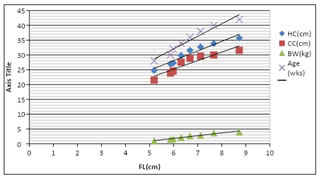
Graph 1: Distribution of the FL with gestational age and other Anthropometric parameters
Table 2: Distribution of the GA and various other anthropometric parameters
From Table 2 and Graph 1 it is clear that all parameters including GA were in linear equation with FL the equations of line and regression coefficients were GA (weeks) y = 4.231FL + 6.672, R² = 0.946; HC(cm) y = 3.262FL + 8.508, R² = 0.937; CC(cm) y = 2.884FL + 7.883, R² = 0.865 ; BW(kg) y = 0.919FL - 3.717, R² = 0.955.
DISCUSSION Neonatal period is a more vulnerable period of life, and its death accounts for 60% of all infant mortality rate and 40% of all deaths of under-five children. Global infant death rate is approximately 8 million/year, of which 4 million deaths occur during the neonatal period. Most neonatal deaths - 75% occur in the early neonatal period and 25-45% during the first 24 hours of life. Most of neonatal deaths occur in developing countries. India contributes 20% of global birth and 25% of global neonatal death. Birth weight (BW) is the single most important factor for the outcome of neonate. Approximately 80% of all neonatal deaths are due to low birth weight (LBW),prematurity, infection, birth asphyxia, and birth trauma in both developed and developing countries. In India, 30% babies are LBW as against to about 5-7% in western countries and also is in second place in South Asia region.6-12 In our country, 70-80% of deliveries are conducted at peripheral level, where taking accurate weight and assessment of gestational age is very difficult because of non-availability of weighing machine and trained personnel. All these factors lead to failure of early identification of LBW and preterm babies who require urgent referral to higher center for extra care.13-14 Foot length (FL) is one of the measurements, which can be measured very easily, bears good correlation with BW, good predictor of gestational age, rapid to perform, can be measured in critically ill neonates and level III neonatal intensive care unit (NICU).15, 16 FL is a very simple, easily accessible, and more reliable anthropometric measure and valuable to assess the BW and Gestational Age in preterm neonate and term neonates. For measuring the newborn FL does not require any special training and equipment.17, 18 In our study we have seen that At GA 28- 5.19±1.23, 24.79, 21.54, 0.975; 30- 5.87±1.45, 26.94, 23.89, 1.52; 32- 5.98±1.98, 27.28, 24.57, 1.67; 34- 6.31±2.87, 29.86, 27.54, 2.13; 36- 6.68±2.39, 31.57, 28.86, 2.68; 38- 7.12±1.63, 32.69, 29.58, 2.87; 40- 7.67±2.37, 33.89,29.98, 3.69; 42- 8.73±3.01, 35.74, 31.58, 3.98 respectively the FL (cm), HC(cm), CC(cm), BW(Kg) respectively. All parameters including GA were in linear equation with FL the equations of line and regression coefficients were GA (weeks) y = 4.231FL + 6.672, R² = 0.946; HC(cm) y = 3.262FL + 8.508, R² = 0.937; CC(cm) y = 2.884FL + 7.883, R² = 0.865 ; BW(kg) y = 0.919FL - 3.717, R² = 0.955. These findings are similar to Ilangovan Rakkappan et al they found The mean FL for term babies observed in this study is 6.91 cm with a standard deviation of 0.44. The mean FL for preterm babies is 5.94 cm with a standard deviation of 0.43. Statistically by performing Scheffe’s multiple comparison test the FL was found to be significantly different in Appropriate for gestational age (AGA), Small for gestational age (SGA), and Large for gestational age (LGA) babies. Statistically by performing Pearson correlation coefficient, the FL correlated significantly with gestational age (GA), head circumference (HC) and Chest circumference (CC), and Birth weight (BW). By performing the regression equation, FL has the potential to predict the gestational age.
CONCLUSION It can be concluded from our study that Foot length (FL) significantly correlated with Gestational age (GA), Head circumference (HC), Chest circumference (CC), and Birth weight (BW) hence it can be considered as proxy measures of other anthropometric measurement, in the places where other anthropometric parameters are difficult to measure this simple measure is very useful for early detection of low birth weight, IUGR etc.
REFERENCES
|
|
 This work is licensed under a Creative Commons Attribution-NonCommercial 4.0 International License.